
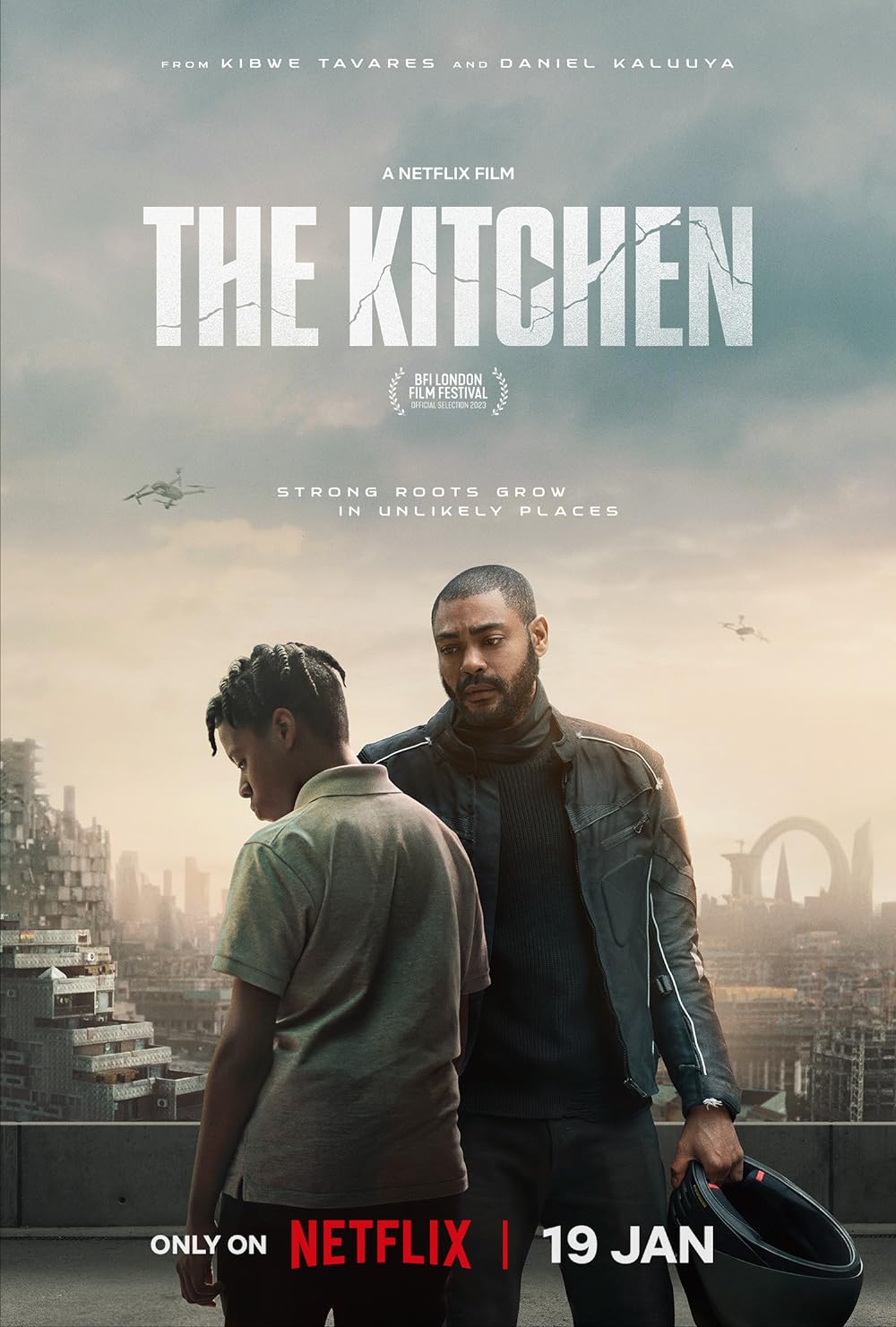
The Kitchen released on Netflix on Friday, Jan. 19. The film follows Benji, a boy whose mother recently passed away. He meets Izi, a man he believes could be his father. The pair navigates life, as London eliminates all social housing and their neighborhood fights back.
This is marketed as a sci-fi/thriller, but let’s be clear — it’s really not. I would classify this as more of a drama, highlighting the issues of suppression and the divide between the rich and the poor, while having the relationship between Izi and Benji at the center.
Right from the start, The Kitchen sets the foundation for this dystopian, futuristic atmosphere very well. It is shot in a way that allows you to see the struggles that one community is facing, while a more prosperous area is just in the background. The production value is very high, really immersing you in this world.
The best aspect of this movie to me was the characters. Kano’s Izi and Jedaiah Bannerman’s Benji were well-written, and their connection was very easy to become invested in. One character always runs away from his problems, while the other is coming off of a tragedy and is just looking to fit in. Both of these narratives were mixed seamlessly, culminating into a satisfying conclusion for both characters.
One other interesting thing that I took away from The Kitchen was how it utilized sound, or the lack thereof. There are several moments that completely cut the sound, and you’re left almost sitting right with the characters, feeling the weight of what is going on around them. This captured my attention in multiple instances, and added to the experience of the film as a whole.
This movie is 107 minutes long. It is a slow-burn and there are moments when it drags, but still, most of the scenes felt meaningful to me. At times it became slightly repetitive, and probably could have been kept 5-10 minutes shorter.
In the end, The Kitchen is an impactful drama flick that takes its time building up the characters and relationships. The themes explored here aren’t far off from reality, and the messaging hits home in the final act. I’d recommend giving this a shot — it might not be up everyone’s alley, but it hit a lot of the right notes for me.
Rating: 3.5 out of 5

