
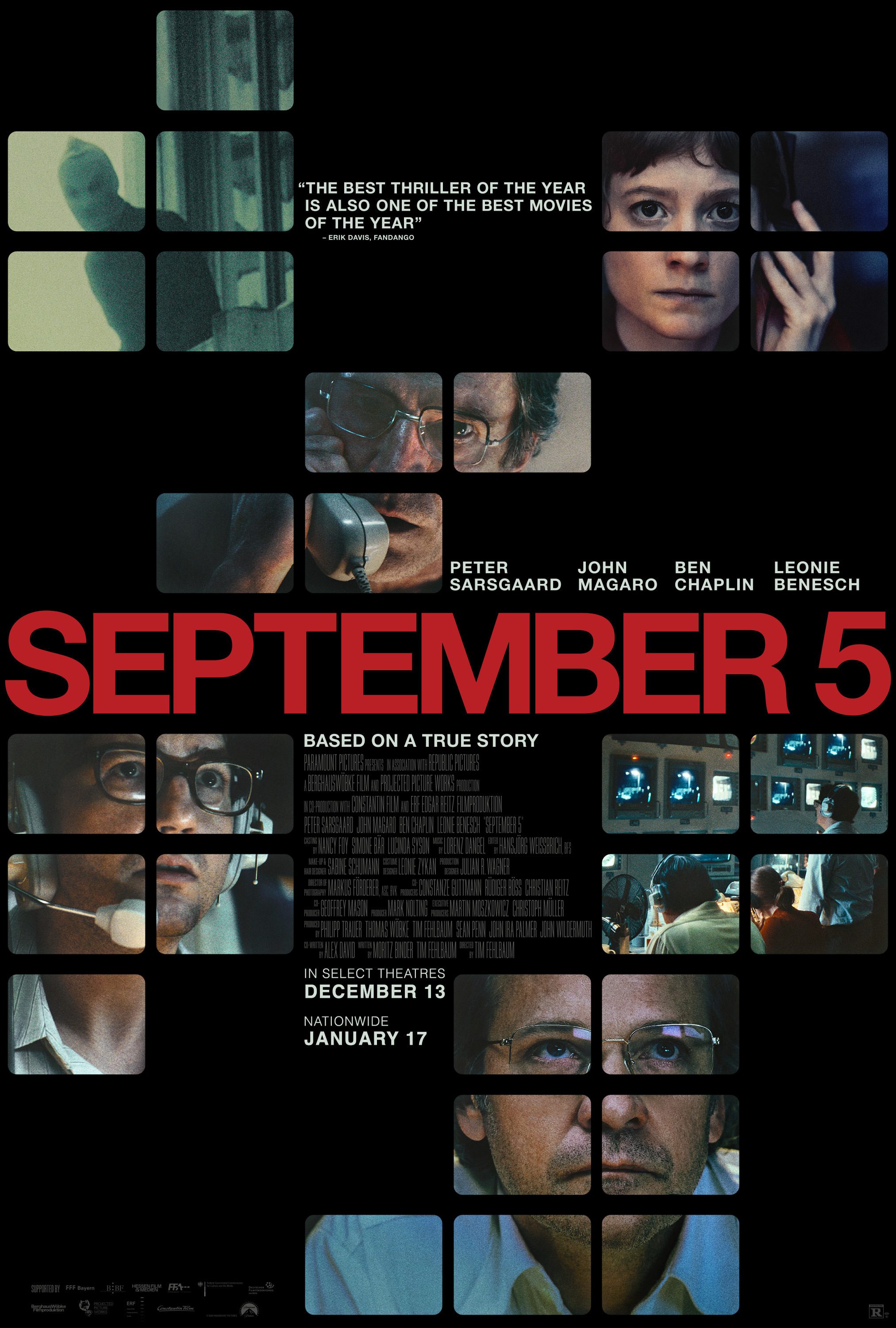
September 5 follows an American sports broadcasting crew that finds itself thrust into covering the hostage crisis involving Israeli athletes at the 1972 Munich Olympics.
September 5 has a near-impossible task at its start: establish the political nature of the story in a neutral way and introduce an array of important characters… while also remaining entertaining. September 5 is able to do all of this precisely, and quickly move into the actual plot.
September 5 features a story that involves politics and history, but that’s not what the movie is about. The audience is seeing the situation entirely from the journalists points of view, and how their actions warped how the rest of the world saw the events as well.
With the large majority of the 95-minute runtime taking place in a control room, September 5 has a lingering sense of claustrophobia. The collection of screens and constantly rolling footage feels like it is caving in on the room of sports reporters that are out of their typical realm. This, mixed with incorporating real archival ABC footage from the 1972 Munich Olympic games adds another layer of realism to the movie.
Peter Sarsgaard as Roone, John Magaro as Geoffrey, Leonie Benesch as Marianne and Ben Chaplin as Marvin each give tremendous performances. Magaro, especially, is responsible for many of the movie’s most impactful moments. He is able to sway between a variety of emotions with grace, depicting an accurate portrayal of “having the weight of the world” on your shoulders. Sarsgaard never has to reach drastic highs or lows in his performance, but his steady-leveled dialogue is memorable amidst the shroud of chaos as well.
At the conclusion of September 5, the screen reads, “900 million people were watching.” This marks the monumental nature of the day, as it was the first time that an act of terrorism was broadcast around the world. It also cements this as a crucial moment in journalism, as ABC’s coverage not only possibly helped the terrorists but shaped an inconclusive narrative of what was actually happening. The effects of this are still seen today, with modern technology allowing pretty much anyone to make a spectacle out of tragedy.
September 5 isn’t about the high-stakes hostage situation at the 1972 Munich Olympic games, but more so about the sports reporters that covered it. Will a person’s professional ambitions cause them to fall into greed rather than fact? Is journalism about the truth or about being first? The film generates these questions and asks the audience to decide what they would do in this situation as well. It’s fast-paced, immersive and thrilling. September 5 celebrates true journalism, while also acknowledging its downfalls.
Rating: 4 out of 5
