
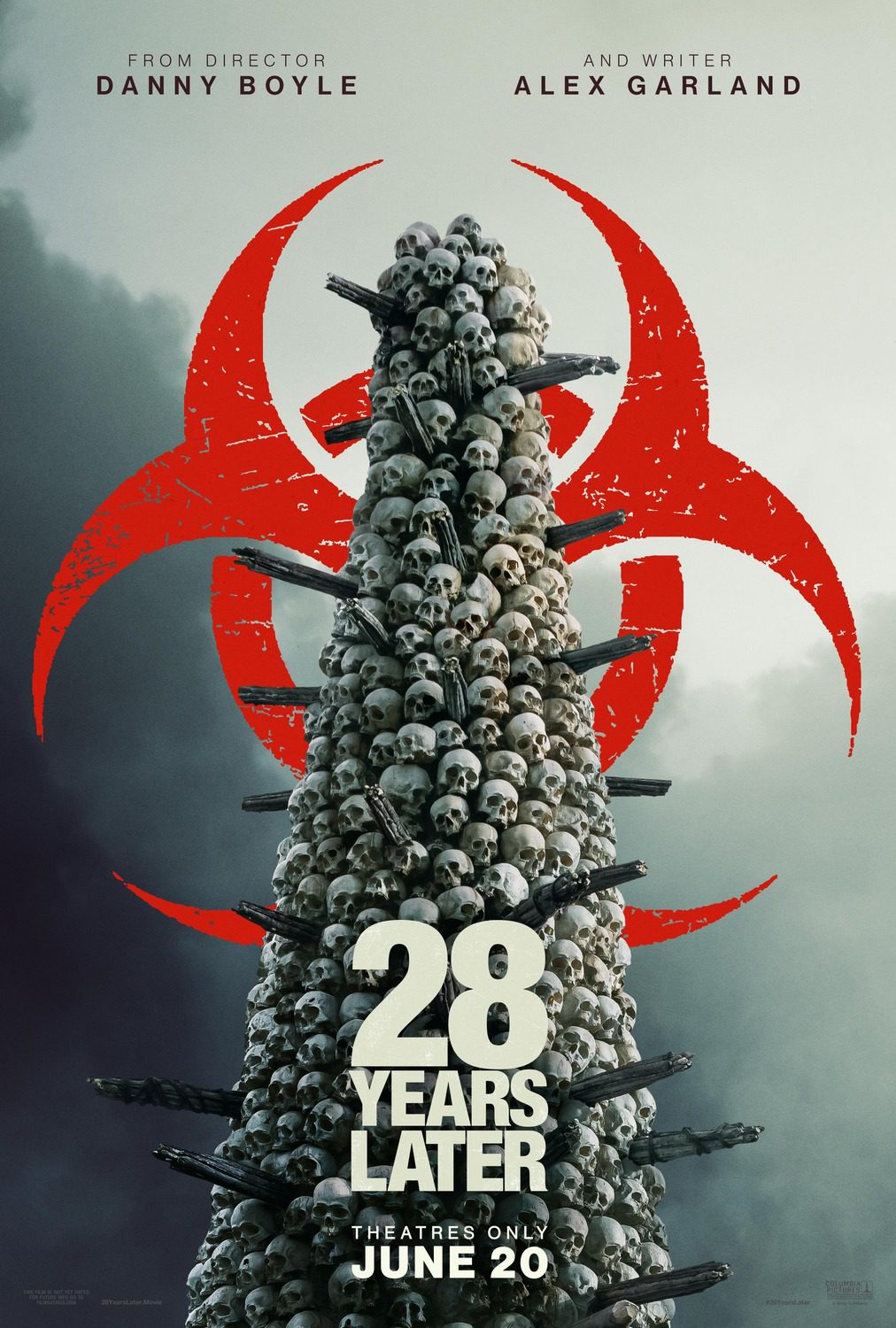
The infected are evolving – too bad the story isn’t.
“28 Years Later” follows Spike, who leaves his small island to venture into the mainland, where he soon discovers a mutation that has spread to not only the infected but other survivors as well.
A Disjointed Journey Through the Apocalypse
“28 Years Later” is a lot of things. Literally. It never settles down, constantly shifting from idea to idea without ever committing to one.
Because of this, the film plays like a post-apocalyptic mixtape. There are an abundance of cool ideas being explored, but none of them have time to breathe. What we get instead is a collection of hollow segments stitched together into a feature-length film.
This is especially disappointing because the first 30 minutes offer incredible character development. The flick devotes much of its opening act to one particular bond, only to completely abandon it. What starts off energetic and promising quickly turns pointless.
That’s the entire story of “28 Years Later.” I was constantly hooked by fascinating ideas, but before I could blink, they were already gone.
Zombie Carnage is Chaotic but Compelling
The film retains the fast-paced, jolting editing style that helped define the original. It’s jarring in the best way, keeping you on edge with aggressive cuts and frenzied camerawork. Add in a phenomenal score, and you get moments that practically vibrate with tension.
If you come for the zombie action, there’s plenty of flesh and blood to go around. While it over-relies on CGI at times, “28 Years Later” adds new stakes to the infected and delivers several jaw-dropping action sequences. Choreography, camera movement and sound design elevate these scenes into full-throttle chaos.
Some moments feel cheesy, but most bring the heat.
Cast Outshines the Script
Despite losing sight of its most intriguing characters, the cast still makes them feel alive. Alfie Williams stands out as Spike, anchoring the film with raw emotion. Some of the movie’s most pivotal scenes ride entirely on his performance, and he delivers.
Aaron Taylor-Johnson, Ralph Fiennes and Jodie Comer all succeed in their supporting roles. Edvin Ryding brings some much-needed comic relief, and his presence adds personality to a film in desperate need of it.
The cast makes “28 Years Later” far more tolerable than it should be. Dialogue issues are consistently present throughout the 115-minute runtime, but the actors do just enough to smooth out the rough edges.
“28 Years Later” justifies its existence in moments. However, most of it plays like a sizzle reel of disconnected ideas rather than a cohesive story. Spike’s journey is full of promise, but it’s told in fragments that never quite connect. By the end, I didn’t feel closure – just exhaustion.
The rage virus remains fierce; it’s the rest of the film that feels dead on arrival.
Rating: 2.5 out of 5
