
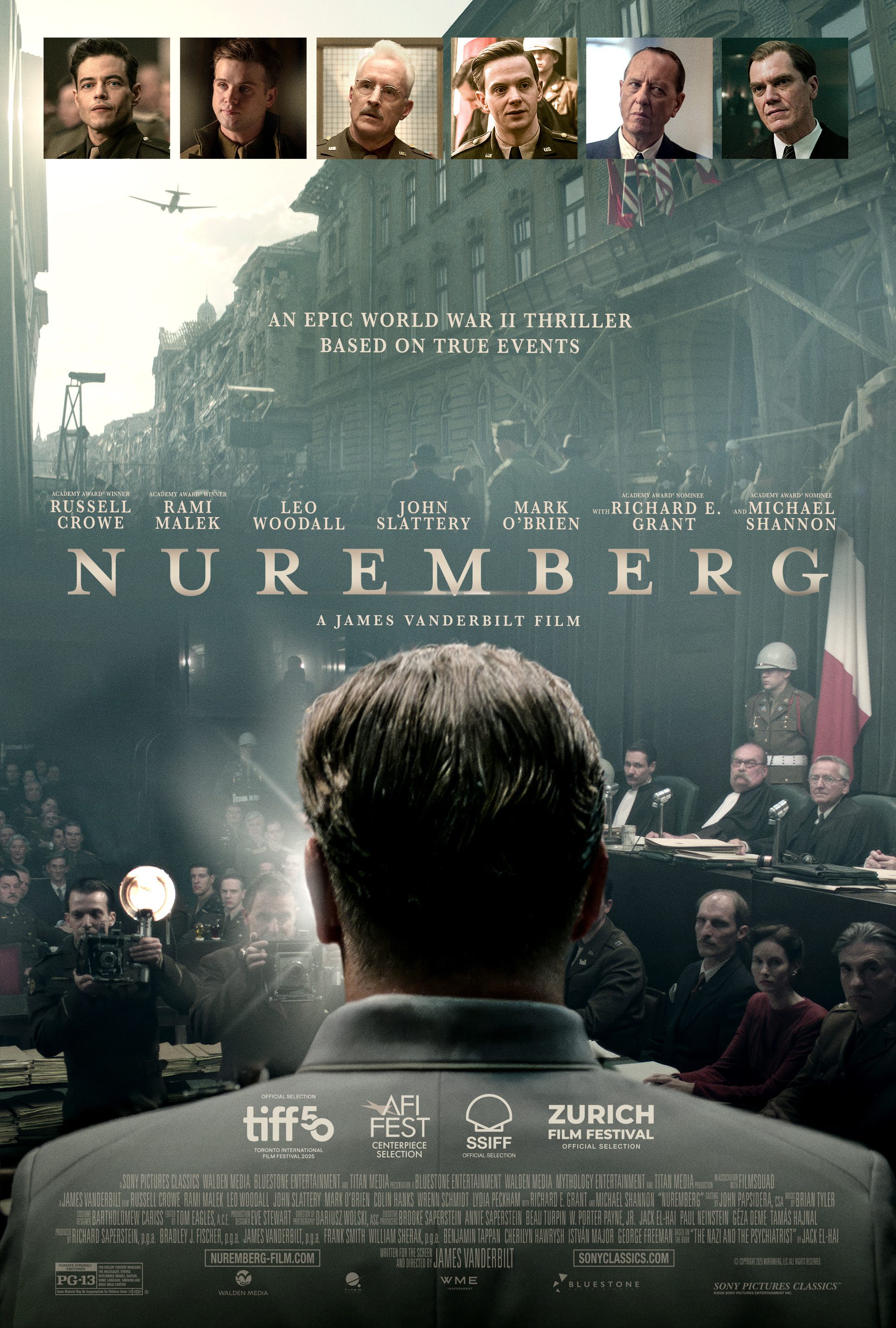
“Nuremberg” follows a U.S. Army psychiatrist who gets locked in a dramatic psychological showdown with accused Nazi war criminal Hermann Göring as the Nuremberg trials are set to begin.
This could have been a fascinating look at the Nuremberg trials. Sometimes it is. Other times it’s not. “Nuremberg” ultimately puts its focus on one of the least interesting elements, and it struggles because of this. The movie has an American-first approach, leaving out many important aspects from the real-life story.
“Nuremberg” feels more like a summary of events than anything else. Sequences of exposition connect the dots throughout the 148-minute runtime rather than bolstering the story. The movie attempts to check boxes instead of showing a complete picture.
Because of this, the first half of “Nuremberg” is tonally inconsistent with the rest of the film. It seems unable to find its footing in the early stages – including bizarre jokes and an uneven setup. The movie is largely uninteresting… until the trial begins.
A Moral Gray Area
“Nuremberg” is an at-times confused movie. Sometimes it’s a warning, while at others it… almost sympathizes with Nazis. The film doesn’t directly do this, but it does focus on their charismatic personalities over the horrors they committed.
This makes “Nuremberg” a frustrating viewing experience at times, but also an important one. By presenting the Nazis as ordinary human beings, it heightens the film’s themes of evil. Seemingly normal individuals have the power to commit some of the world’s greatest atrocities – which translates to the polarizing political climate we see in modern times. This approach challenges viewers to think in ways they normally wouldn’t.
“Nuremberg” heightens this effect by including real archival footage. While the film may seem uncertain in moments, the inclusion of such footage makes its condemnation clear. While uncomfortable to watch, “Nuremberg” leaves no doubt that there is no place for crimes like the Holocaust in our world.
“How is that possible? What I just saw… how is it possible?”
Performances and Perspective
“Nuremberg” has an all-star cast, with performances from Russell Crowe (Hermann Göring), Rami Malek (Douglas Kelley), Colin Hanks (Gustave Gilbert), Michael Shannon (Robert H. Jackson) and more.
Crowe delivers a haunting performance, bringing charm and evil to the screen at the same time. Each line echoes across the film, with his presence towering above everyone else. Malek goes toe-to-toe with Crowe in a more subtle and subdued role. While he doesn’t match Crowe’s intensity, the pair bounce off each other in constant psychological warfare.
Writer-director James Vanderbilt manages to make this a mostly successful historical drama. While not fully accurate, he balances the emotions, educational value and messaging of this story well. This isn’t an easy story to tell. Because of this, it goes off the rails in moments – but Vanderbilt always manages to get it back on track.
“Nuremberg” isn’t trying to appeal to the masses. It explores human nature and the evil that lies within in ways that will be overtly uncomfortable to many. While bloated and uneven, its powerful messaging and timely importance make this a historical drama worth watching.
Rating: 3 out of 5
