
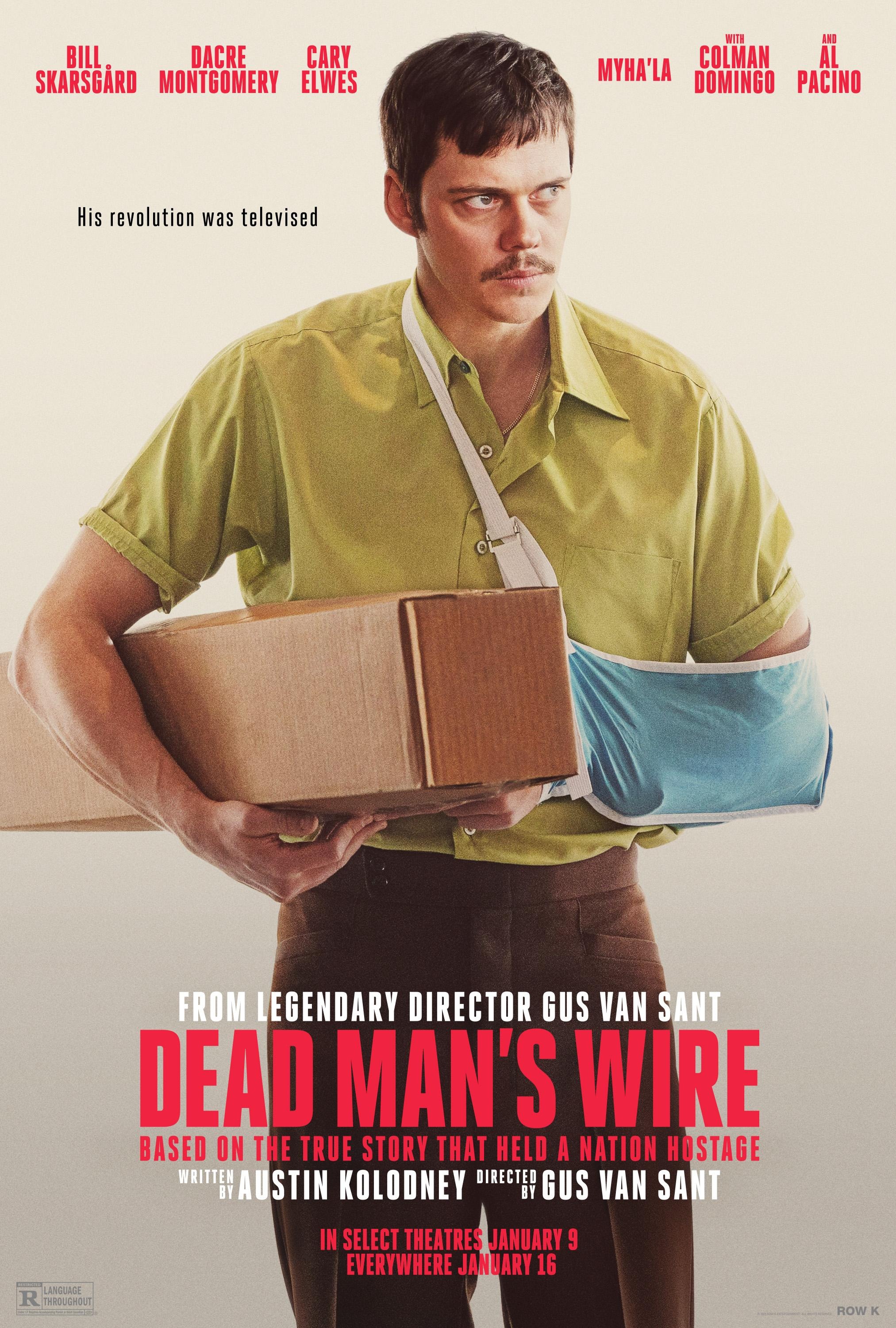
“Shitshow” is commonly thrown around in “Dead Man’s Wire.” A film that is anything but that.
“Dead Man’s Wire” is based on a true story. It begins on Feb. 8, 1977, as Tony Kiritsis enters the office of Richard Hall, president of the Meridian Mortgage Company, and takes him hostage.
This Isn’t Your Typical Hostage Thriller
It’s a movie that tackles many topics – economic inequality, media narratives and desperation.
The journey may feel like a “shitshow” at times. And that’s exactly what it is trying to be.
“Dead Man’s Wire” doesn’t just focus on a singular character. Instead, it prominently highlights four individuals – Kiritsis (Bill Skarsgård), Hall (Dacre Montgomery), Fred Temple (Colman Domingo) and Linda Page (Myha’la). While the central dynamic between Kiritsis and Hall is the heart of the film, it also makes an effort to share different perspectives on the issues at hand.
It’s because of this that the exploration of these ideas feels so well-rounded.
Despite taking place in the past, the film’s “rich versus poor” identity is very relevant today. By fleshing out Kiritsis as an individual, the audience is able to sympathize with what may have drawn him to these extreme lengths. At the same time, you can also feel for Hall, who is privileged yet partly tormented due to his own father’s doings.
This dynamic allows “Dead Man’s Wire” to flourish. It’s not attempting to make the audience feel one way or the other. It’s an “underdog story” that acknowledges the flaws of every individual involved. It also recognizes the shared emotions of desperation that so many people probably experience every day.
Media, Momentum and Modern Relevance
Temple and Page play a role in the film’s messaging as well. Incorporating media into the mix adds another layer of stakes. “Dead Man’s Wire” takes place in an entirely different media landscape… but it really hasn’t changed much.
This isn’t as central as the Kiritsis-Hall standoff, but it does shape the movie’s broader perspective. As a viewer, it’s easy to get caught up in the emotions of a situation. The film itself mirrors this. By continuously shifting perspectives, the layers of the story are always changing – even when you feel confident about who is at fault.
A Unique Style with Performances that Stick
The direction from Gus Van Sant and editing by Saar Klein reinforces this approach. “Dead Man’s Wire” can be inherently simple one moment, then deliberately “choppy” the next. It integrates black-and-white stills in the middle of scenes and combines digital textures with vintage aesthetics.
Danny Elfman’s score works in tandem. It’s part jazz, part rock, and feels perfectly at home within the time period.
With locations rarely changing, this jolting style keeps the pace energetic. Because of it, the 105-minute runtime flies by.
Skarsgård continues to show his range. Here, he’s a ball of everything – rage, desperation, sadness and even humor. He effortlessly brings the character to life, finding comedy in obscure moments and pure menace in others.
Alongside him is Montgomery, who is nearly as impressive. While not chewing up the scenery like Skarsgård, Montgomery makes a lasting impact. He brings real fear to the screen, often in subtle ways.
Domingo, Myha’la, Al Pacino (Fred Temple) and Cary Elwes (Michael Grable) are all strong as well. Domingo, especially, brings his usual gravitas, elevating scenes with calm authority.
“Dead Man’s Wire” is jam-packed with great performances. Alongside its distinct direction and relevant themes, it leaves a lasting mark on the crime-thriller genre.
Rating: 4.5 out of 5
