
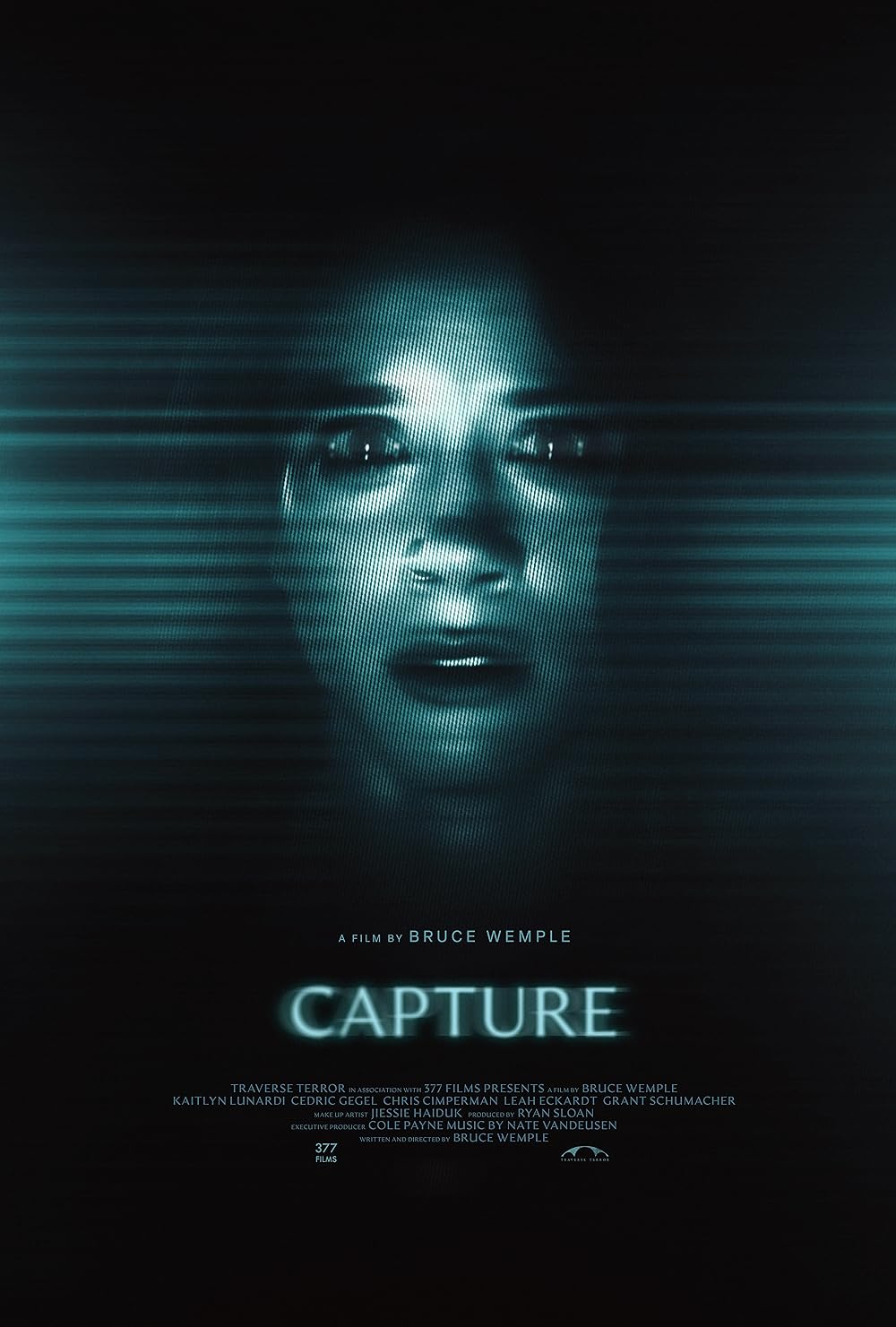
“Capture” follows Abby, who inherits her parents’ house and finds a camcorder alongside a collection of video tapes that contain the gruesome secrets of her family’s past.
Abby is a compelling character. Growing up in the foster care system, she doesn’t have an established sense of family. Yet, she learns (somewhat forcibly so) about her own throughout the course of the 85-minute runtime. As Abby faces her own obstacles like alcoholism and codependence, this provides an interesting dynamic as she watches her parents’ prior struggles as well. Kaitlyn Lunardi (Abby) brings the character to life. Lunardi’s not only constantly looking in fear, but she also adds brief stints of emotion. Her range from sadness to fear to anger is impressive.
The central narrative is a simple one: a character watches tapes that progressively grow more sinister. It’s easily digestible on the surface, but much more complex as the layers begin to be peeled back. Another similar recent release, “Undertone,” takes this same approach. There, it’s listening to audio files — in “Capture,” it’s watching video tapes. Unlike “Undertone,” this film doesn’t hold back its punches until the last moment. It continuously unravels scares as the narrative progresses, only getting meaner in the process. While many horror movies rely on jump scares, “Capture” earns them.
It can easily be labeled as a “rule breaker” by unnaturally switching camera angles and inserting abrupt screeching audio. Director Bruce Wemple creates an experience that can feel like it’s all too much at times, and that’s purposefully so. It’s because of this that “Capture” continues to surprise with jump-worthy moments. I don’t often get affected by jump scares. When a movie is able to get me, that’s high praise. This not only achieved that once, but several times. So often, in fact, that it left me frustrated (in a good way).
While the creep-factor continuously rises, the film struggles to fully trust its audience. This is typically done through dialogue, as characters spell out key points or reveals rather than letting them play out.
“I found a camera. I think it’s evil.”
Don’t let the fact that “Capture” is a low-budget production fool you. On a technical level, it succeeds on virtually every level. Wemple’s cinematography plays a role in cementing the film’s identity. Background objects are constantly obscured and blurred. Footage seamlessly shifts between modern cameras and a camcorder. Various lighting sources are also used to add flickers of tension to darkness. The film’s sound design adds to the anxiety even in moments when horror is absent. Closing doors, waves of thunder, phone vibrations, creaking floorboards and other everyday noises carry extra weight. Mixed with Nate Vandeusen’s score, the audio proves to be an immersive experience of its own.
For fans of carnage candy, there’s enough to satisfy your cravings here. “Capture” doesn’t have an in-your-face style with the gore, but it’s certainly present. And when the movie goes for it, the practical effects shine. Jessie Hajduk brings her A-game in the makeup and effects department to generate a repetitive, gnarly visual that is memorable on its own.
Rather than concluding with scares, however, “Capture” decides to end on a more emotional note… or so you think. Until the final frame, the film keeps asking questions, leaving you wondering what was real and what was not by the time the credits roll.
With such a short runtime, certain aspects of “Capture” are limited. Underdeveloped isn’t the word to describe the movie’s shortcomings, but specific moments can feel brushed past. This will likely leave many engaged viewers hungry for more, in both positive and negative ways.
“Capture” is undoubtedly on par with a number of recent mainstream releases. It’s a creative tale with an even more creative outcome. If you’re in search of an underrated independent horror film, this is it.
Rating: 4.5 out of 5
