
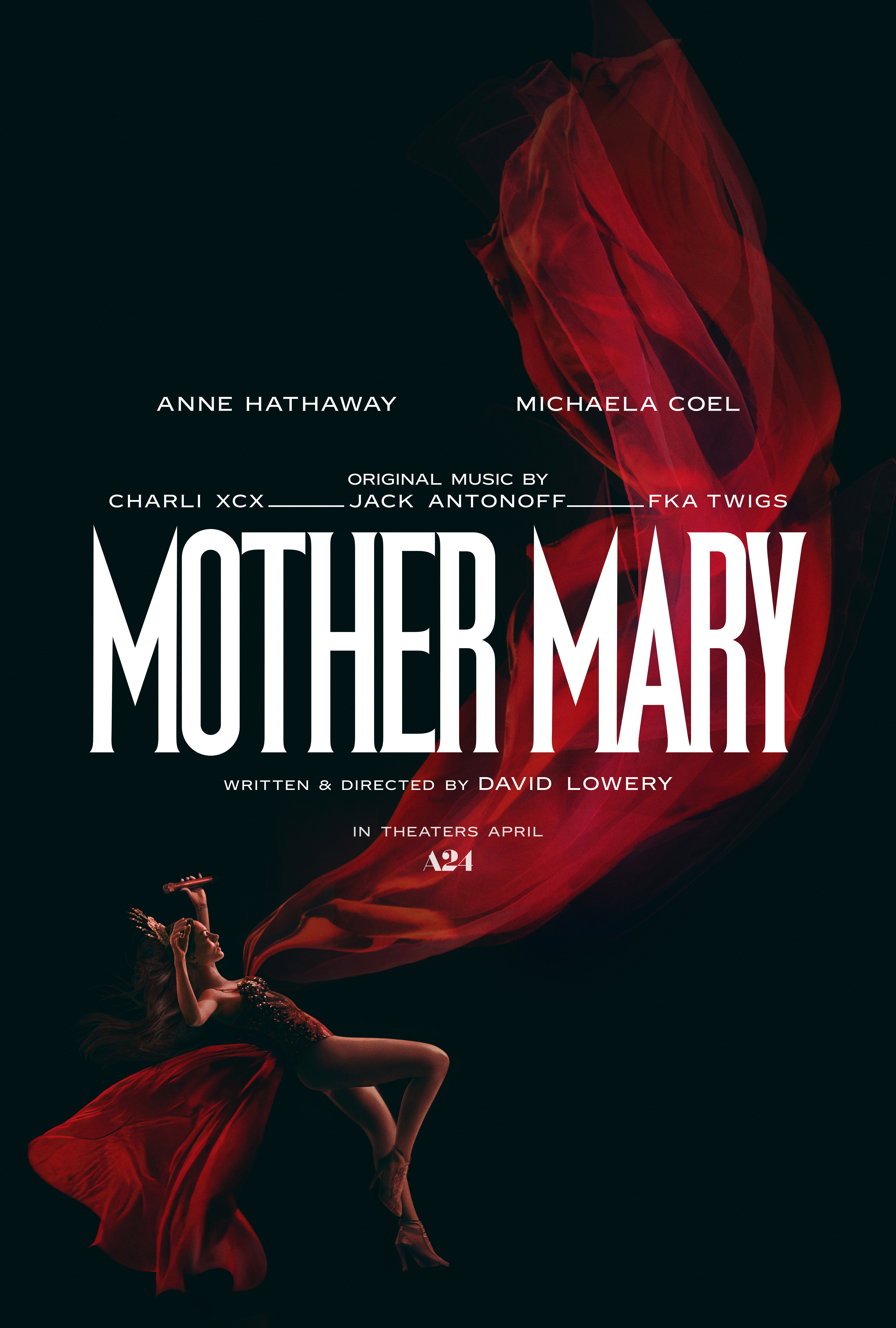
“Mother Mary” follows iconic pop star Mother Mary, as long-buried wounds rise to the surface when she reunites with her estranged best friend and former costume designer Sam Anselm on the eve of her comeback performance.
Tension is immediately present in “Mother Mary.” Not because of what happens onscreen, but because of the unknown. The film introduces its characters with minimal backstory, dropping the audience directly into the plot. Because of this, simple conversations and small decisions carry an abundance of weight, leaving you wondering what the ultimate destination will be.
The storytelling isn’t always chronological. Between the endless bouts of dialogue, “Mother Mary” intermixes flashbacks and dreamlike fantasies that expand the characters’ ideologies. Through the editing, these scenes seamlessly flow without breaking the simplistic structure.
The posters may say, “this is not a ghost story,” but that’s not necessarily true. Rather than serving a physical, grounded role in the narrative, this ghost is more of a metaphor. “Mother Mary” explores the fractured friendship between Mother Mary and Sam, and the supernatural elements of the film play a role in examining this — all of the pieces that have held them together and torn them apart.
“These metaphors are exhausting.”
When this works, it works. However, it takes too long to become the focus. Despite brief excursions, the early stages of “Mother Mary” are grounded; full of simplistic conversations (and massive concerts). With David Lowery at the helm, however, that can only last so long. Similar to previous works like “A Ghost Story” or “The Green Knight,” Lowery’s latest installment verges purely into a metaphorical realm. It becomes a collage of disconnected moments that form a singular foundation.
It’s a “mess” at times because of this… but it’s a good one. Relationships are messy. Life is messy. The movie itself serves as an examination of the inner complexities of humans and our connection with others.
The cinematography from Andrew Droz Palermo and Rina Yang aids in keeping a distinct visual style intact. Depending on the setting, the film mixes dimness with vibrancy, managing to blend moments of intimacy and spectacle. The color red is also a powerful anchor to the film. And it’s an effective choice because it can mean so many different things.

This doesn’t excuse some of the script’s shortcomings, though. As “Mother Mary” moves further into the surreal, it loses the original simplicity that it possessed. The fantasies become the focus, seemingly forgetting many of the initial plot threads in the process. In turn, the characters also suffer, becoming more akin to symbols than people as their individual identities get pushed aside.
This leaves the first half and second half of “Mother Mary” feeling almost like two different movies. As the 112-minute runtime progresses, more segments of the film end up being both long-winded and tonally jarring.
For fans of music, there’s plenty of it here. The soundtrack features original music by Charli xcx, Jack Antonoff and FKA Twigs. But don’t forget about Daniel Hart’s score. It mimics the characters’ emotional states throughout the entirety of the film, shifting between soft hues and loud strings.
“Mother Mary” is also underratedly funny in moments. The film isn’t attempting to be a comedy, but the performances from Anne Hathaway (Mother Mary) and Michaela Coel (Sam Anselm) help alleviate some of the tension. Coel, specifically, has a number of one-liners that instantly generate laughs.
“How on Earth are you gonna sing while you do all that?”
Hathaway and Coel bring much more to the table than that, however. Hathaway succeeds in both her physicality and delivery, executing dance routines and singing that make her feel like a real “pop star.” She is also vulnerable, with facial expressions doing a lot of heavy lifting amid silence. Coel is more direct, delivering monologue after monologue in a monotone fashion. She is constantly calculated, which bounces off Hathaway’s more unorganized persona.

“Mother Mary” grows increasingly weird with each passing minute. What starts as a simple story about a broken friendship quickly turns into a fantastical tale. In classic David Lowery fashion, it’s boldly abstract — for better or worse.
Rating: 3.5 out of 5
