
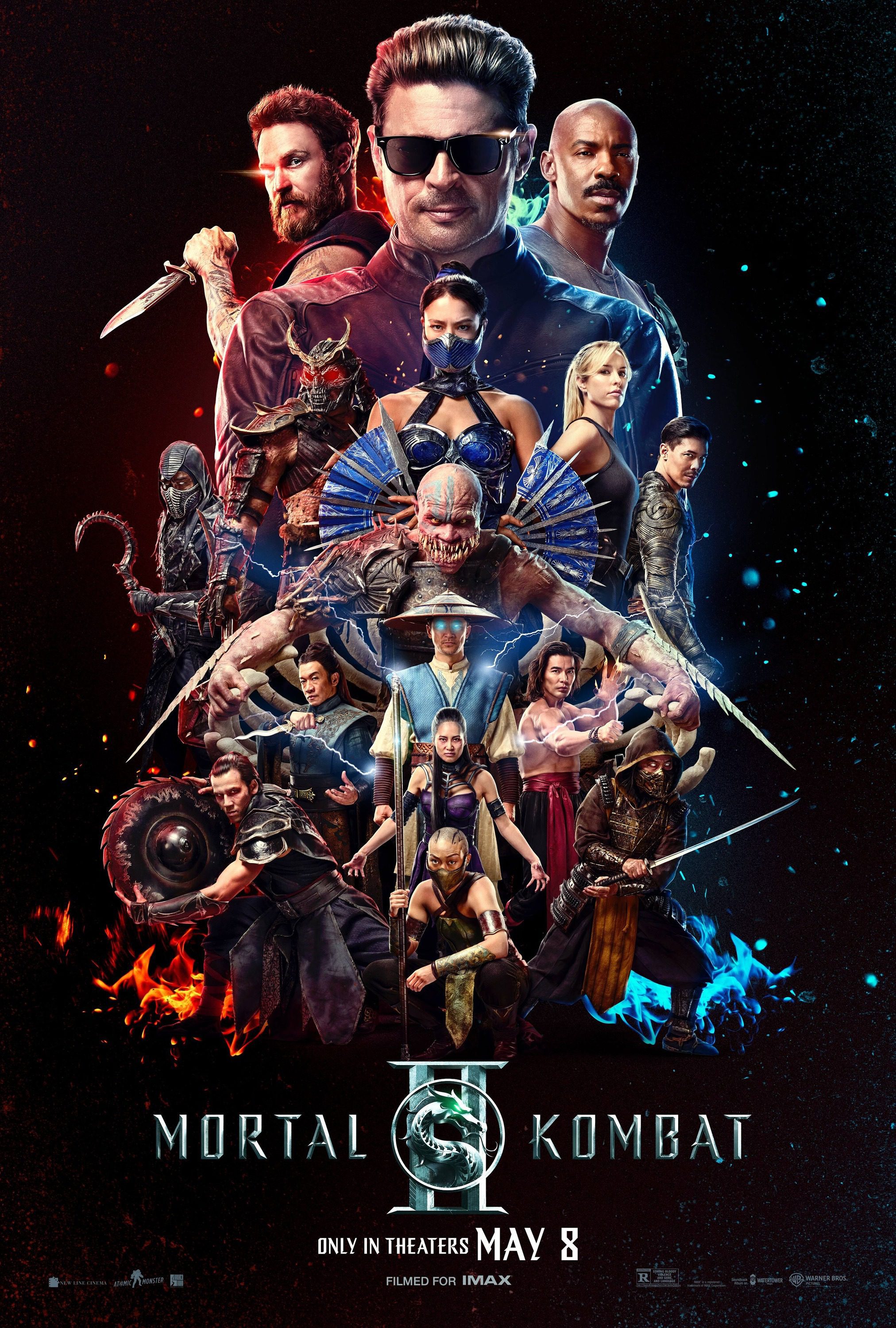
“Mortal Kombat II” follows Earthrealm’s champions, now joined by Johnny Cage, who are pitted against one another in a battle to defeat the dark rule of Shao Kahn.
Much like 2021’s “Mortal Kombat,” if you’re a fan of the games, you’ll probably have fun with this sequel. It has everything its predecessor had (plus more). More characters. More action. More lore. More blood. The stakes are all raised here, for better or worse.
Jeremy Slater’s script is messy. The first third of “Mortal Kombat II” is void of true tension. Because the film focuses on the titular Mortal Kombat tournament, it contains scene after scene of fighting. In doing so, it never really builds up to anything except… more tournament match sequences. At the midway point, the film hits its stride. Somewhat escaping a cyclical nature, it pushes the story in familiar yet different trajectories. While pausing the carnage could result in eye rolls from fans of the game, it’s actually a breath of fresh air here — because after all, this is a movie. All of this culminates in a final act that is convoluted. After putting the pieces in place, director Simon McQuoid doesn’t fully know what to do with them. Because of this, character arcs shift with minimal buildup and the story splits in various directions.
All the while, the 116-minute runtime moves by in a flurry. Having little interest in the previous installment, it was to my surprise that “Mortal Kombat II” was nearly over when I first checked the time. With constant action and little in between, the movie doesn’t waste a second. In fact, it could even be said that it’s too short. With so many ideas jam-packed inside a sub-2-hour length, the narrative oftentimes feels haphazardly thrown together.
On his own, Johnny Cage is annoying — by design — but nonetheless… annoying. When the martial arts movie star is surrounded by other strange individuals, however, he becomes more charming. Despite a somewhat rocky start, Karl Urban (Johnny Cage) manages to transform into the character as the runtime progresses. So much so, in fact, that he actually begins to chew up the scenery.
Adeline Rudolph (Kitana) is the co-lead. In a more emotional role, she is able to sell the kind-hearted nature of her character. At the same time, she also brings an abundance of physicality. More often than not, it’s Rudolph who actually has the spotlight over Urban. While not delivering charming one-liners, she adds a much-needed sense of depth to an otherwise “meta” experience.
On the opposition is Martyn Ford (Shao Kahn). He makes the antagonist feel truly threatening with his massive size. Ford’s performance is less about words and more about presence.
Rounding out the ensemble cast are Jessica McNamee (Sonya Blade), Mehcad Brooks (Jax Briggs), Ludi Lin (Liu Kang), Lewis Tan (Cole Young), Tadanobu Asano (Lord Raiden) and Josh Lawson (Kano).
Many of these “side characters” generate effective comedy. Lawson, specifically, effortlessly delivers line after line of humorous dialogue. While there are brief instances where the humor goes too far, Lawson’s Kano is the one who lands the most laughs.
If you come for slow-motion action, “Mortal Kombat II” has plenty of that for you. Is the fight choreography almost always “cool?” Indeed. But… there’s still way too much slow-mo here. Despite McQuoid’s insistent overindulgence, the tournament scenes each prove memorable in their own ways. With different settings, characters and obstacles introduced every time, they each add a unique flair. And there’s plenty of blood to go along with it. The film doesn’t hold back on the gore, showcasing brutality in each kill.
There has been a lot of talk about the CGI in “Mortal Kombat II.” In actuality, it’s not that bad. Like most modern blockbusters, the film contains visual effects in virtually every shot. While there are a number of slightly distracting moments, there are plenty more that are jaw-dropping.
Director of photography Stephen F. Windon adds interactivity to the fights while also keeping them basic. At times, the camera follows the action closely. In others, it’s framed like a shot from the game. The film also utilizes its IMAX format well, with the expanded ratio providing further immersion.
After all the good, “Mortal Kombat II” remains a strange experience. This may work as a video game, but once again — this is a movie. Characters speak in expository fashion like they’re guiding players into the next mission. With every progression, this injects an unnatural tone that simply doesn’t “feel” right. The visuals themselves take on a “cut scene” effect at times as well. This leads to sudden pauses in fights or bizarre transitions. While these creative choices work for nostalgic purposes, that should only be on occasion. Here, fan service is relied on far too much.
“Mortal Kombat II” is an improvement upon its predecessor, bringing the story back to its roots. That doesn’t mean it’s good. The film throws everything but the kitchen sink onscreen, overshadowing the positives within.
Rating: 2.5 out of 5
