
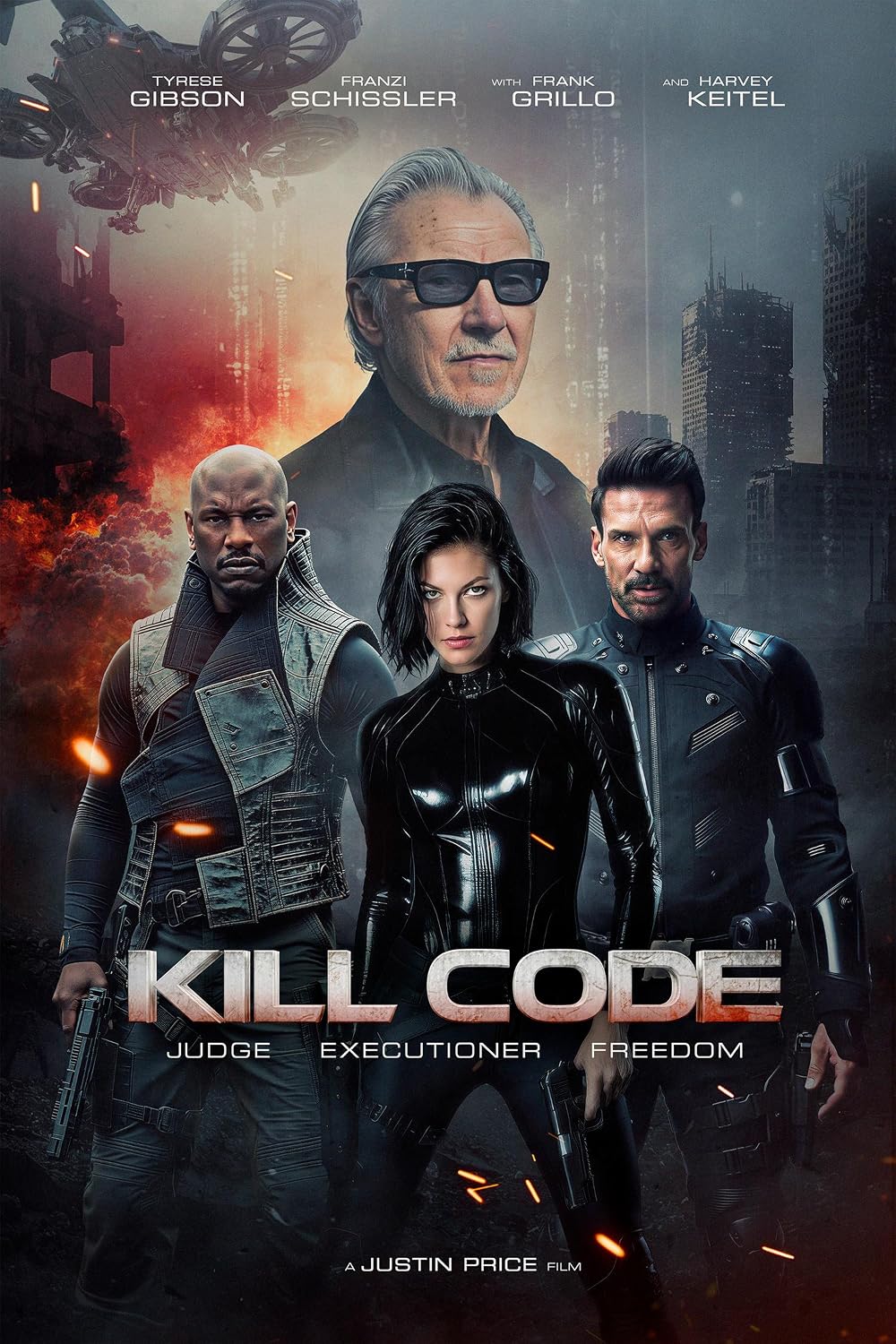
“Kill Code” takes place after the Second Civil War, where Alpire Industries promises lasting peace through the ONYX Program. Cyber-enhanced operative Elera uncovers the truth, joining a rogue resistance to destroy the mainframe before AI turns all of humanity into targets.
If you come into “Kill Code” expecting additional lore about this complicated premise, you might want to keep waiting.
Here we go again… “Kill Code” offers another opportunity to discuss artificial intelligence in film production. It stands alongside several other 2026 releases, including “Stop! That! Train!,” “Chum” and “Young Washington,” that have utilized the tool. Here, it’s quite ironic — considering the movie itself centers around the dangers of AI.
Out of the bunch, it’s clear that “Young Washington” has been the most successful (while still containing noticeable flaws) in its implementation. In “Kill Code,” however, it’s used for both transitionary shots and the action itself. Within are all of the classic tell-tale signs: exceptionally short clips, unnatural textures and overall low resolution. On top of the jarring visuals, this also makes the film challenging to engage with strictly from a story perspective.
While setting up the world, writer-director Justin Price struggles to craft a cohesive narrative. The early stages shift between scenes of dialogue, abrupt violence and futuristic environments. At times, it appears like “Kill Code” is actually progressing through 5-second clips, making it almost impossible to follow.
Not all is bad, though. Director of photography Filip Vandewal alongside production designer David L. Snyder and costume designer Critter Pierce bring some life to the “futuristic” landscape. On the surface, every setting in “Kill Code” feels largely modern. Simple techniques like colorful light sources and rundown locations are used to distinguish it from the ordinary. Throw in some sleek black outfits, and there you go — the future. There is also some merit to the action in instances where it doesn’t rely on obvious generative AI. These are few and far between, though, growing to the point where it virtually feels like you’re scrolling on 𝕏.
On-the-nose comedy is interwoven into the identity of the film as well. The most obvious is Harvey Keitel’s Eion, being just one letter off from a very notable public figure. Frank Grillo (Benjamin) seems to be aware of the project’s silliness, immediately bringing an absurdist presence that is completely out of line compared to the rest of the cast.
“If you really wanna tickle my taint, Eion, you better give me something to prevent me from pulling the plug on your little science experiment in the next two days.”
“Kill Code” does feature a talented ensemble. Alongside Keitel and Grillo are Tyrese Gibson (Lukas), Franzi Schissler (Elera), Jacob Artist (Kyron), Sescily Leon Connell (Noel) and Brett Cullen (Sawyer). In this instance, there’s not much to say beyond their names alone. The actors come and go to deliver their lines, but it’s unclear if they even understand what’s going on within this world. Because of this, most of the delivery falls flat.
“Kill Code” relies on AI to tell a story about AI. There are brief moments where an intelligible narrative seeps through, only to be overshadowed by more digital clutter.
Rating: 1 out of 5

