
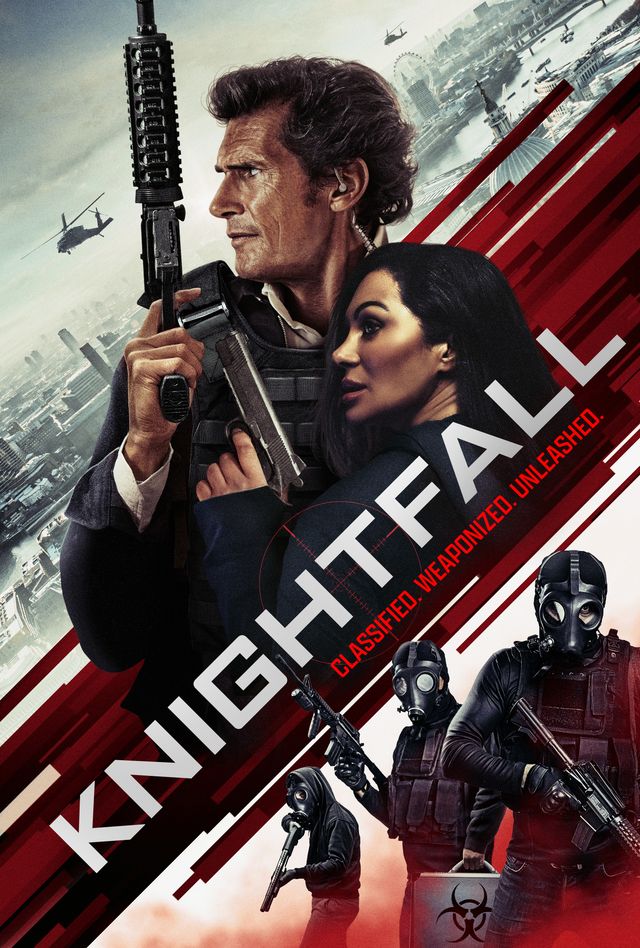
“Knightfall” follows Charles Knight, a paranoid former spy catcher who must work with his daughter to foil an international terrorist plot.

Director Ben Fortune immediately establishes that “Knightfall” is an old-school spy thriller. Everything — from the music to the characters to the stakes — makes this clear. Logan Jones’ score features orchestral arrangements that give the film a classic “James Bond”-esque vibe. Then come the characters, who deliver articulated lines while acting with precision in combat. The screenplay, written by Robert Dunn, James Smy and Bob Schultz, sets up a world-ending scheme that needs to be halted.
“We screw up tonight and the world gets a lot more dangerous… for everyone.”
While the central premise revolves around Charles Knight, “Knightfall” is about much more than him alone. In fact, the character doesn’t even appear until nearly halfway through the 83-minute runtime. Because the film was written by committee, it feels like it’s focusing on a committee as well. It’s an ensemble effort rather than a solo one, with a plethora of characters for viewers to keep track of.
Even with its shortened length, “Knightfall” remains sluggish in between the thrills. This is mainly because of the characters. Rather than standing out in the genre, they each fall into stereotypes. Jeanine Nerissa Sothcott’s Ros Knight is the hyper-intelligent scientist thrown into the middle of madness. Geoffrey Moore is her loving boyfriend. Ian Ogilvy is her over-protective, retired dad. Additional individuals are also present for double-crosses and backstabbings — which are mostly easy to see coming but still fun. It’s the lack of time that causes the resolutions to be less-than-shocking. None of the individuals are fully fleshed out, making them feel more like pawns on a chessboard rather than actual people.
Sothcott’s character is the emotional core of the movie. The “weight of the world” is placed on her shoulders, and she has the most emotive performance of the group because of this. Ogilvy has an arrogant, judgmental persona. Acting as the titular character of sorts, Ogilvy has the charismatic personality for it, but it’s not like he’s an action star akin to Daniel Craig. It’s his delivery that is relied upon to convey Charles’ wits and skills. Moore is calm, collected and charming. The son of former James Bond actor Sir Roger Moore, Geoffrey has the same suave and confident portrayal that is required in this type of role. Also appearing are Rupert Holliday-Evans (Julian Pollard), Robert Cavanah (Ivan), Michael Paré (Matthew) and Nick Moran (Carmichael).
With large segments made up of these cliché-riddled characters interacting, the visual narrative falls behind the verbal storytelling. The movie begins telling its objectives rather than showing them. In the process, it loses sight of the central threat: a deadly bioweapon. As characters analyze plans, new faces and possibilities, the momentum becomes halted. What should be a race toward the finish typically ends up in a slow jog. Still, there is effective action amid all the talking, combining hand-to-hand combat and gunfire. Similar to Steven Soderbergh’s “Black Bag,” these moments aren’t flashy, with simplistic choreography that gets in and gets out.
Director of photography James Westlake often shoots in dark settings. Taking place in rural, desolate environments, Westlake and Fortune take a minimalistic approach to lighting scenes. This includes floodlights, flashlights or even laser sights. The camerawork shifts between static and handheld, with subtle shakes and movements that add an interactive touch to the action.
“Knightfall” is short but not always sweet. The film has a charming cast and nostalgic spy-thriller aesthetic but lacks a gripping story around it.
Rating: 2.5 out of 5
