
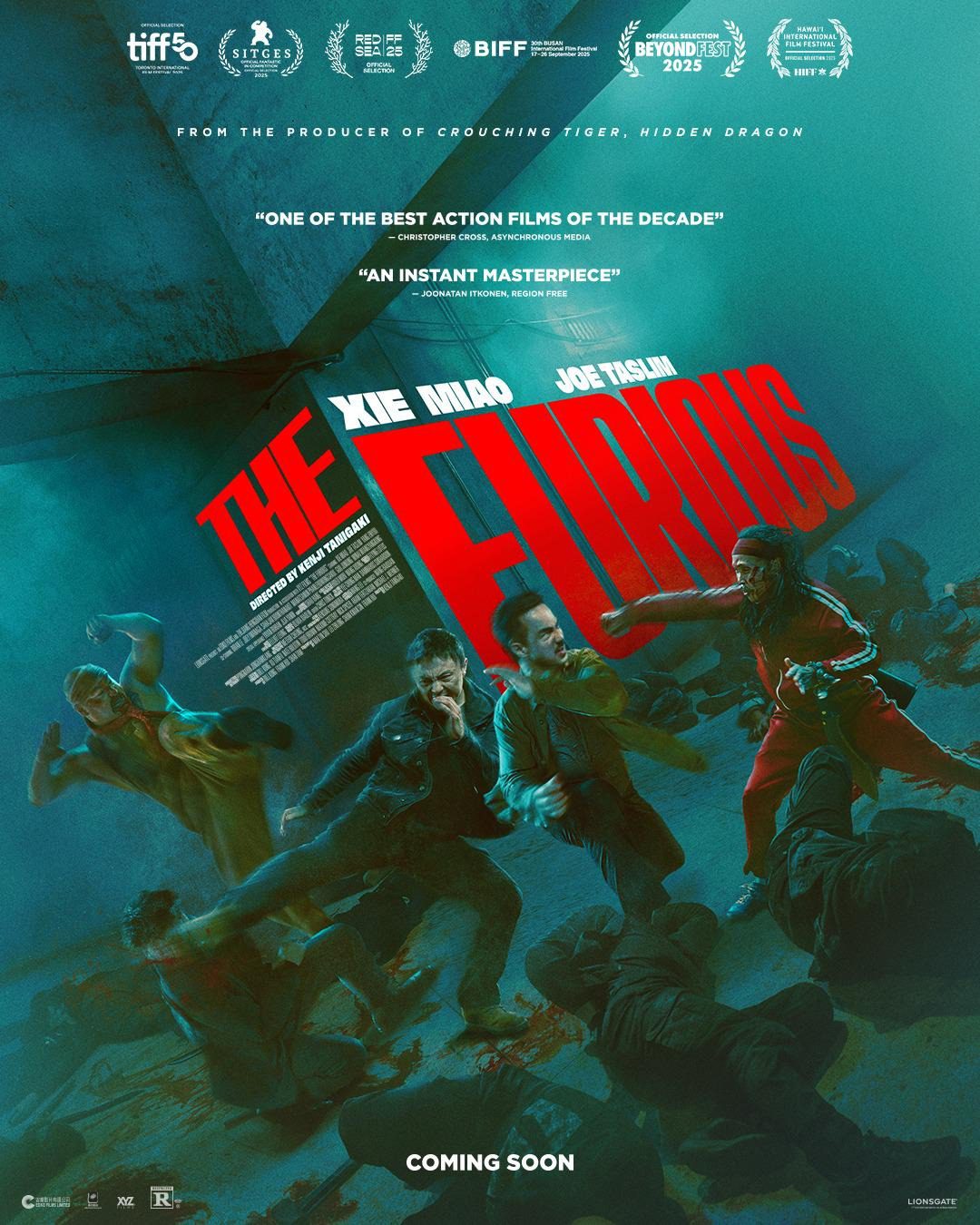
“The Furious” follows Wang Wei, who teams up with a journalist whose wife mysteriously disappeared, on a rampage to find his daughter after she is kidnapped by a criminal network.
Director Kenji Tanigaki doesn’t pull his punches. Within minutes, “The Furious” rewards viewers with exactly what they came to see, which is creative martial arts action. Prior to the title card appearing at the 5-minute mark, there’s already a high-octane fight that just scratches the surface of what follows.
Within each fight scene, there are a plethora of moving pieces. Rather than growing stale, “The Furious” remains inventive because it feels like it’s pushing the human body to the limit — unorthodox bending, full-blown sprinting, rolling across the ground. It’s not always hand-to-hand combat either, occasionally adding various weapons into the mix. In similar genre entries, you would expect there to be cuts in between all of this. Here, choreography is king. Tanigaki clearly prioritizes unbroken takes, letting all of the action unfold. Because of this, there’s a touch of authenticity that is hard to replicate. For fans of Nikhil Nagesh Bhat’s 2024 film, “Kill,” this will likely be right up your alley.
What makes it even more impressive is that “The Furious” maintains this consistent level of quality throughout the entirety of the 113-minute runtime. While you may think the stakes are immediately high, they only grow larger.
The actors deserve a lot of the credit for bringing these scenes to life. Co-stars Xie Miao (Wang Wei) and Joe Taslim (Navin) actually appear to be moving at 2x speed — despite no fast-forwarding — with how fast they spar. While the physical presences of everyone involved are commendable, the dialogue itself is a different tale. Miao doesn’t suffer from this problem, playing a silent character who communicates through sign language. This makes his delivery stand out from the rest of the cast, especially as automated dialogue replacement was heavily utilized in post-production for the English-language finish. This is nowhere near as distracting as in a recent movie like “Chum,” but the issue is prevalent nonetheless.

It’s not only the action choreography that is engaging. Tanigaki and director of photography Meteor Cheung keep simple scenes interactive. While characters carry out basic conversations, there are flames erupting from cooking food or cars speeding by. All of this occurring in the background makes “The Furious” visually stimulating from beginning to end.
There is a major problem, though; it’s all about the action. Mak Tin Shu, Lei Zhilong, Shum Kwan Sin and Frank Hui’s screenplay is designed only to get the characters from point A to point B. It’s a plot that’s obviously akin to the likes of “Taken,” but also virtually any other hostage rescue movie. Outside of the innovative martial arts fighting, there’s nothing new here story-wise. It’s clear that Tanigaki’s priority is on combat (as it should be), but the script still fails to make the narrative as a whole overly memorable.
Who really came to “The Furious” for the story, though… right? Its insistence on providing chaos over conversation means the entertainment never pauses. Because of this, the somewhat lengthy runtime usually doesn’t feel overblown.
All of this culminates in a conclusion that can be described by one word: bonkers. Nothing more needs to be said, except that everything that comes before it is somehow upped yet another notch.
“The Furious” brings a fury of original action-packed moments. The story itself is missing this ingenuity, but the well-staged violence elevates the film to an elite tier in martial arts cinema.
Rating: 4 out of 5
