
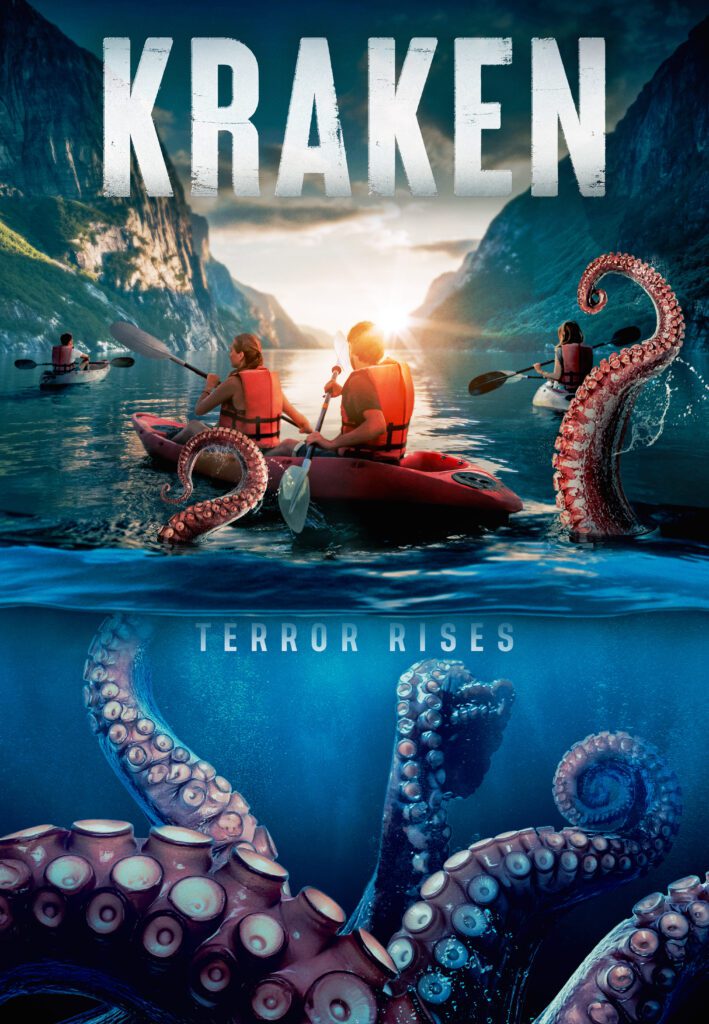
“Kraken” follows Johanne, a marine biologist who encounters several strange occurrences near Norway’s deepest fjord, where a mythical monster with a myriad of arms rests.
There’s a growing trend of creature features having the ultimate titular monster, but getting sidetracked with other animals. “Jurassic World Dominion” sidelined the dinosaurs with giant locusts. “Meg 2: The Trench” became focused on a kraken, coincidentally, alongside dinosaurs, rather than the megalodon sharks. Here, “Kraken” opens with 30 seconds of Kraken action, followed by an hour of… fish farm drama.
For most of the 100-minute runtime, “Kraken” explores a “nature-versus-humanity” scenario. In this instance, it takes place on an aquaculture fish farm that uses ultrasonic sound waves to vibrate parasites off salmon. What’s the catch? The fatal flaw of humans is that we don’t know when to stop. While the giant sea monster isn’t inherently realistic, seeing people exploit technology for personal gain is. Because of this, the subplot here feels more earned than those in “Jurassic World Dominion” and “Meg 2: The Trench.” However, that doesn’t mean it belongs in this specific movie.
Every viewer seeking out “Kraken” is coming for one reason — the Kraken. Director Pål Øie doesn’t seem to care about this fact, however, which is both admirable and frustrating. One reason for this could be the written-by-committee design. Vilde Eide, Kjersti Helen Rasmussen and Natasha Arthur wrote the script based on an original story by Øie and Sjur Aarthun. At times, it’s a simple character drama. In others, it’s a preachy environmental thriller. By the end, it does go full-blown creature feature. The problem is that they all feel distinctly separate instead of whole.
This fragmentation leads to both tonal inconsistencies and pacing issues. After the initial tease, audiences will likely be hungry for more monster mayhem. It eventually comes, but arguably it’s a classic case of “too little, too late.” The plot development grows tedious because of this, never fully moving past a compilation of ideas.
The characters themselves aren’t overly interesting, either. “Kraken” has subplots regarding romance, environmental activism and corporate interests. Despite spending large portions of time on them, they still feel underdeveloped. The cast delivers serviceable performances to keep these moments somewhat engaging. Sara Khorami (Johanne) stars, along with Mikkel Bratt Silset (Erik), Øyvind Brandtzæg (Avaldsnes) and Jenny Evensen (Maria).
Those who can get through the hour of “fluff” will be rewarded with what the title promises. With one-third remaining, the Kraken finally becomes the star of its own movie. This is when “Kraken” is at its best; the definition of turn-off-your-brain fun.
What “Kraken” also has is stunning cinematography by Aarthun. The Norwegian setting is effectively captured, with the fjord waters being both beautiful and haunting. Everything mainly occurs in a single location, but Aarthun blends different environments through above-surface and underwater action. Drones were also a widely used tool in Aarthun’s arsenal, showing the sheer size of the water and what lies within it. That’s not all the film has going for it visually, as the Kraken itself looks superb. The visual effects are surprisingly realistic, mostly because Øie smartly hides the entirety of the creature until the very end. Showing simple tentacles and obscured views, the detailing is teased prior to the grand reveal in the closing moments. “Kraken” does not have a large budget, reportedly under $6 million. You wouldn’t guess this while watching it, though. The effects are purposeful, with the film never succumbing to a “CGI fest.”
There’s a good creature feature within “Kraken” — specifically the last 30 minutes. Outside of that, it falls into the same trap as similar genre entries and isn’t able to escape.
Rating: 2.5 out of 5
