
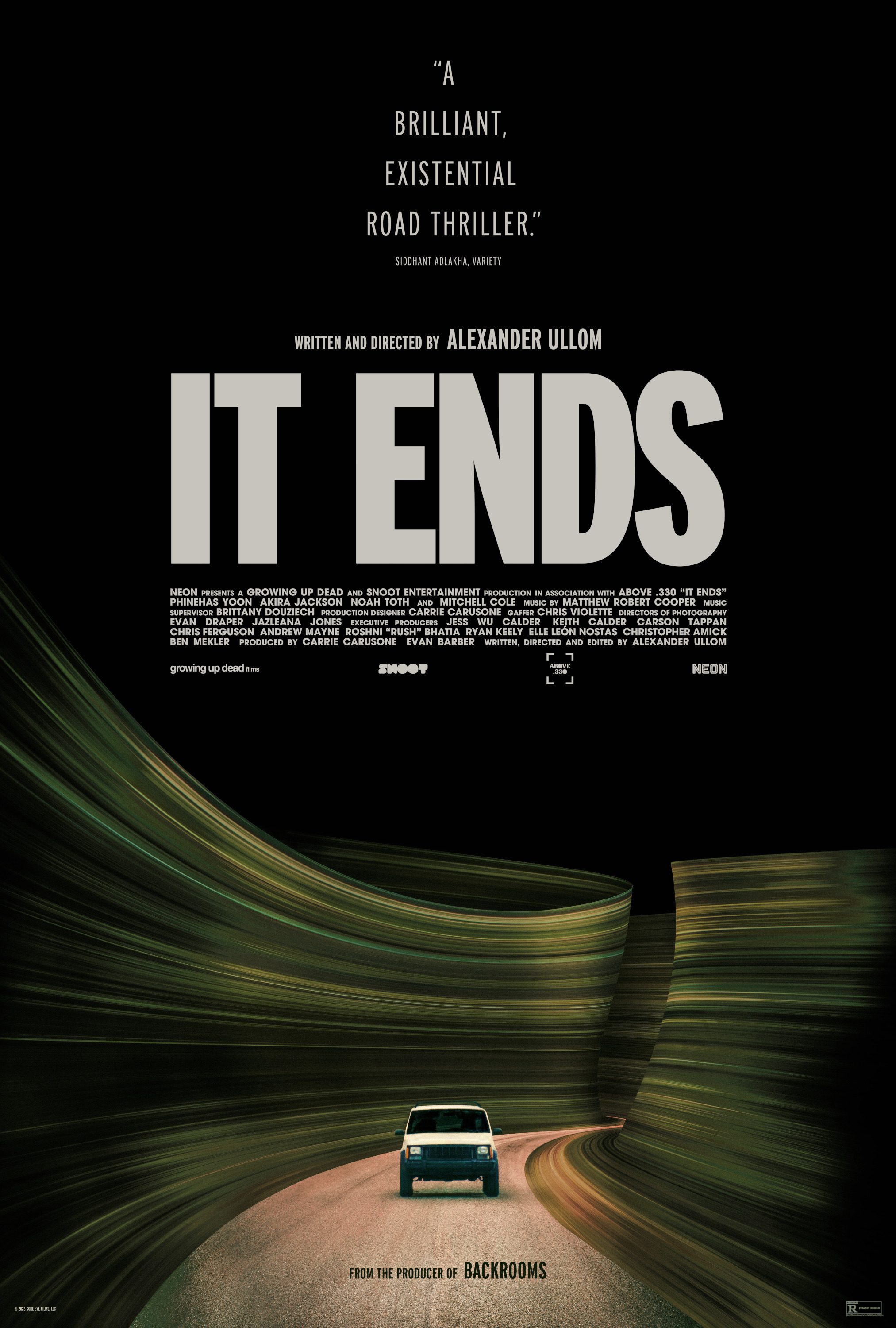
“It Ends” follows a group of recent grads who head out on a late-night drive, accidentally turning onto a never-ending road surrounded by horrors and cosmic forces beyond their understanding.

Writer-director Alex Ullom doesn’t waste time on “traditional” introductions. The film opens with the characters entering a car followed by driving and talking. What do they speak about? For the most part, absolute nonsense. Through these immature conversations, you immediately learn about each of the four leads’ personalities. About ten minutes later, comes an iteration of a question that most viewers are probably also asking: where are you going? As you sit there waiting for the horrors to begin, they do… very quickly.
Rather than feeling forced, the few scares that “It Ends” has are earned because of patience. Similar to André Øvredal’s “Passenger,” the film shares a simplicity in its inherent horrors — desolate drives in the dark are scary. Ullom executes an off-and-on approach that is entirely devoid of terror during large stretches before snapping in an instant. Because of the commitment to silence, the jump scares are actually effective. Really, though, “It Ends” isn’t attempting to be “scary” in the traditional sense. It’s more about the existential dread that comes from being stuck in an endless cycle.
This is where most of the movie’s problems come from, however. Even at only 89 minutes long, “It Ends” can feel interminable. Trapped in a single location, all there is to do is talk. And the characters themselves are written closer to caricatures than real people. Day (Akira Jackson) is the composed realist. Fisher (Noah Toth) is the anxious optimist. James (Phinehas Yoon) is the logistical cynic. Tyler (Mitchell Cole) is the stoic militant. As their sentiment shifts away from apprehension to acceptance, the film begins to lose its flair. Tonal inconsistencies also arise as it attempts to remain abstract among the plainness. Utilizing onscreen text and implementing time jumps, it’s clear that Ullom is reaching for ways to extend the narrative.
“Do you think eventually we’ll have talked about everything ever and just never have any new stimuli ever again?”
While the individuals are stereotypical, the performances themselves feel authentic. Jackson and Toth are the loudest (and most charming) of the group. Jackson brings a sense of endearment that the others lack, remaining charismatic even when things go South. Toth is energetic from the start, delivering childish lines on top of realistic worried outbursts. Yoon is seemingly straightforward, expressing more of his character’s emotions through contemplative thought. There is one scene specifically, though, in which Yoon goes all out, and it’s easily the most memorable of the film. Cole also doesn’t have much to say, with a stoic performance that encapsulates Tyler’s distance from everyone else.
With four people crammed inside a car, the cinematography from Evan Draper and Jazleana Jones is largely comprised of close-ups. As characters interact, the camera remains up close and personal, often cutting off at foreheads or just below the chin. This emphasizes the claustrophobic nature of the setting, while also alienating the audience from the world around them. In this way the method is effective, but there’s no doubt that it’s also distracting at times. Draper and Jones also implement tracking shots from the vehicle to further showcase their entrapment inside rows of trees on both sides.
Throughout their journey, the characters search for a deeper meaning behind what they are experiencing. As with any movie, most viewers will likely be doing the same, which is why the conclusion of “It Ends” is sure to be divisive. It’s an ending that aims for laughs rather than answers, which will instead result in many groans. By the time the credits roll, it all feels a bit… pointless.
Despite its triviality, there are still some takeaways. Focusing on young individuals preparing to enter into adulthood, the entire concept is a clear metaphor for growing up. As you age, life becomes more and more tedious — you do the same tasks every day, lose friends and even forget about parts of yourself. That’s all visualized in “It Ends.” While the messaging is admirable, the same outcome could have been executed in a short rather than a feature-length film.
“It Ends” travels down a long road of false importance only to reach a destination of vacuousness. There are moments of purpose that are overshadowed by boredom.
Rating: 2.5 out of 5
