
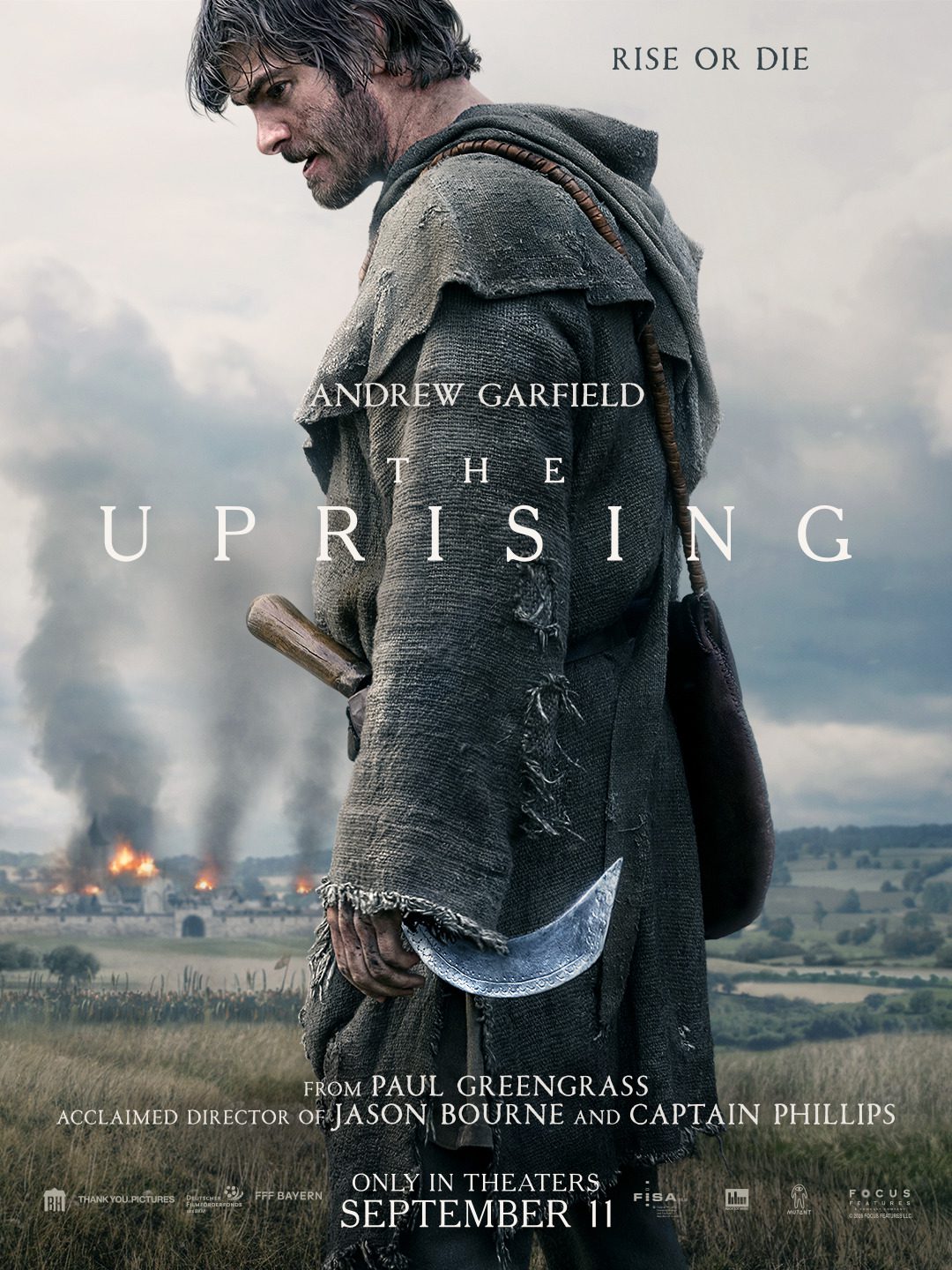
“The Uprising” follows the leader of a ferocious rebellion, as he forms an army of the people against the tyranny of King Richard II in a fight for justice.

Michael Sarnoski’s “The Death of Robin Hood” already offered a different take on Robin Hood in 2026. This isn’t that. Sure, it’s where “the legend of Robin Hood began,” but it’s mainly just a marketing tactic. Instead, this is based on the true historical events of the English Peasants’ Revolt of 1381.
For a movie of this scale, “The Uprising” has a distinct visual style. Writer-director Paul Greengrass and cinematographer Pål Ulvik Rokseth implement a handheld approach, with subtle shakes and not-so-subtle crash zooms consistently done throughout. Over-the-shoulder tracking shots are also present to add to the immersiveness. The lack of stabilization gives the film an authentic aesthetic that replicates the unsteadiness of the characters’ lives. And as the stakes continue to rise, the “shaky cam” only heightens. The third act, specifically, features sequences that are almost headache-inducing — which actually works in the movie’s favor.
There are moments of sweeping drone shots and slow motion. These emphasize the scope of the large-scale action scenes, while also being slightly distracting. Because the rest of the film is so unpolished, they end up sticking out like a sore thumb. William Goldenberg’s editing helps to alleviate some of this, however, transitioning through shots in rapid fashion.
Production designer Nikolaj Danielsen and costume designers Tóth András Dániel and Godena-Juhász Attila aid in replicating the 1381 England atmosphere. On top of the camerawork itself, it’s their work that transports you back to a specific time and place.
“The Uprising” has a 127-minute runtime. It doesn’t feel like it. Right from the start, it injects a “revolutionary” mindset that’s hard not to get behind. This is achieved through both the loud and quiet moments. Immediately, there are atrocities committed by the King’s forces, which result in defiance. The audience is quickly able to get behind Ploughman’s moral compass because of this. At the same time, the film pauses on the characters’ losses — of both people and freedoms. Rather than simply telling viewers how they should feel, Greengrass shows the horrors in full force. This includes brief but graphic depictions of sexual assault, beheadings and other violent acts.
While the story takes place in the past, its messaging is equally relevant today. Exploring class warfare, abuse of power and, of course, uprising, many of the events in the movie still occur to various degrees in modern society. These themes remain at the heart of the narrative each step of the way.
“Every night we will come for you in your dreams, and you will never have peace.”
As “The Uprising” weaves through time, it features several jumps. Some of these are just days while others are entire years. The film has a tendency to reach the middle of an intense moment, only to then transition into the next day. This leaves certain plot threads anticlimactic as Greengrass continues to progress through the story.

Andrew Garfield (Ploughman) stars in a surprisingly quiet performance. He doesn’t say much. He doesn’t even make any overreaching facial expressions. Garfield lets the character’s overwhelming sadness speak for itself. When he does deliver monologues and stentorian messages, they hit all the harder. Also appearing are Woody Norman (King Richard II), Tom Hollander (Treasurer Hales), Cosmo Jarvis (Wat Tyler) and Thomasin McKenzie (Alyce). Norman delivers a versatile performance, triggering emotions of both empathy and hatred that switches at a moment’s notice.
“The Uprising” may have taken place over 600 years ago, but its story remains impactful. Greengrass’ documentary-like style and Garfield’s performance make this both riveting and rewarding.
Rating: 4 out of 5
