
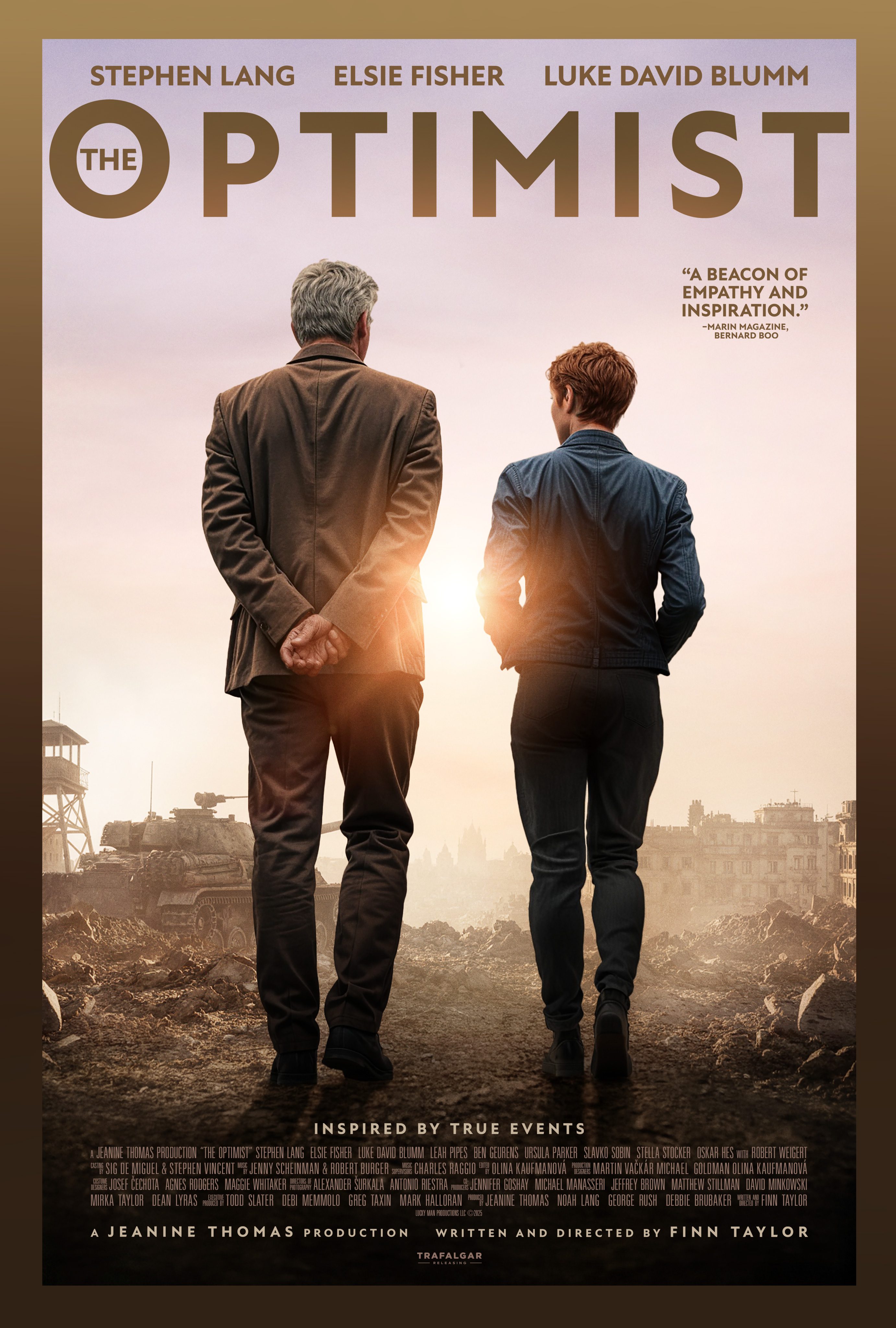
“The Optimist” follows Herbert Heller, a Holocaust survivor who has carried the secret for over six decades. After he meets Abby, a perceptive teenager with her own emotional burdens, they form an unexpected intergenerational bond. It’s based on a true story.

At the center of “The Optimist” is a very complex character in Herbert Heller. He is tormented by trauma: being separated from his family and imprisoned at Theresienstadt and Auschwitz. Writer-director Finn Taylor effectively shows his PTSD through quick flashbacks that are triggered by seeing uniformed officers and stomping boots or hearing leaf blowers. These spurts of memories eventually turn into prolonged backstory that fully develops Herbert’s life as a child. By shifting between his hardships as an adult and as a kid in the past, Taylor makes the character’s optimistic personality feel authentic.
Many probably know Stephen Lang (Herbert Heller) from action-thrillers like “Don’t Breathe” or “Hellfire.” “The Optimist” is not that kind of movie. He delivers a grounded performance that is largely centered on exposition as he recounts the events of his past. Lang’s not bashing in brains or dodging bullets — he’s just a kind old man. It’s a performance full of many blank stares to express his pain and smiles to express his resilience. Lang isn’t the only actor portraying Herbert, however, as Luke David Blumm (Young Herbert Heller) also plays him during flashbacks. Blumm brings plenty of emotion to the screen as the character navigates impossible situations.

Abby is another multi-layered character in this story who is plagued by her own troubles: substance abuse, mental health problems, estranged relationships and the death of a loved one. Rather than diminishing her issues in comparison to Herbert’s, Taylor uses them to create a connection. Elsie Fisher (Abby) has a quiet, anxious energy that many young viewers will be able to relate to. While Lang’s character always seems to have words of wisdom, she stumbles on her sentences and sometimes doesn’t know what to say.
“Maybe it’s because you don’t make me nervous, or maybe it’s because I want to hear your story.”
While reminiscence provides much of the history, it’s this dialogue between the two of them that ties it all together. In this way, it’s similar to another recent release, “Seniors” — just with a much darker edge. “The Optimist” makes you care about both individuals’ experiences by revealing additional information about them as the 102-minute runtime progresses.
There are instances where the film moves too quickly. Because Herbert always knows exactly what to say and where to go, some of the encounters between him and Abby feel forced. On top of this, certain aspects of the characters’ journeys are more fleshed out than others. The pacing also grows inconsistent as large stretches are devoted to Herbert’s past, only to then switch to Abby’s story for brief moments at a time. While the nonchronological structure sometimes gets in the way, the messaging undoubtedly remains intact. History in any form is important. Whether on a global or personal level, there is history to everything and everyone. Taylor asks the audience to remember the past and embrace a better future because of it.
Alongside the performances, the camerawork helps express the film’s sentiment. Cinematographers Antonio Riestra and Alexander Šurkala shoot close-ups of dirtied and bloodied faces, electric barbed-wire fences and torn-up shoes to convey the weight of oppression. While the intimacy remains intact, this darkness is contrasted with the vibrancy of the modern world when shifting to the present day.
“The Optimist” shows that connection can come in many forms. The film delivers a resonant idea: everyone has a past — from surviving the Holocaust to overcoming mental health struggles — that is worthy of being heard.
Rating: 3.5 out of 5
