
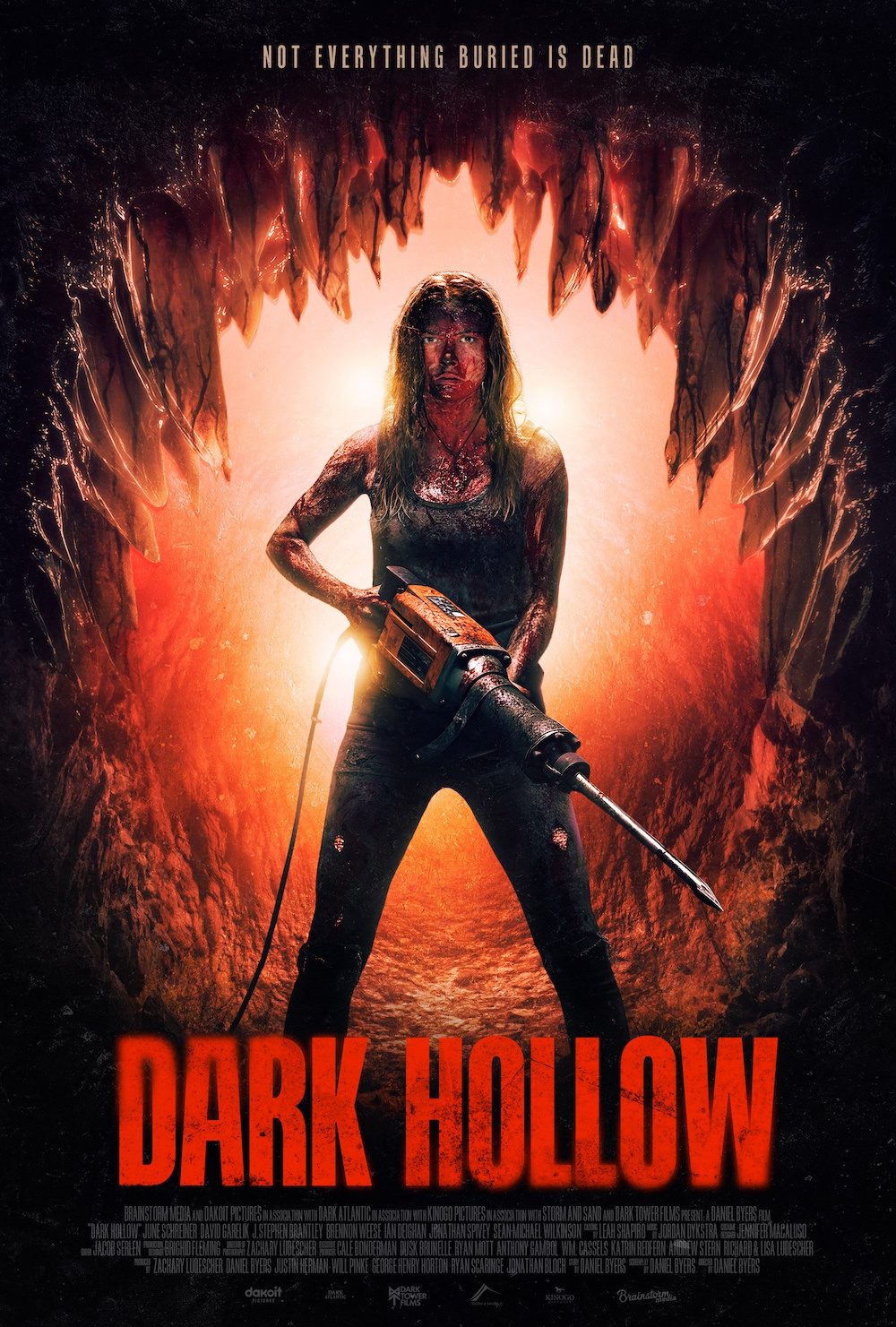
“Dark Hollow” follows a young mother who must protect her home and save her family after a nightmarish monster emerges from the depths of an Appalachian coal mine.

It seems to be the year of the creature feature. While “Dark Hollow” shares this label, it’s much more than that. Rather than serving as the focus of writer-director Daniel Byers’ story, it’s closer to a metaphor, akin to “The Leaching” and “The Room Below.” Instead, the film focuses on a family fighting an eminent domain eviction due to mountaintop removal mining. The correlation is immediately clear, showing the horrors that come from corporate greed and environmental desecration.
Because of this approach, the “creature” is largely missing from the feature for most of the 95-minute runtime. For ordinary genre entries without a dramatic throughline, this screams disaster. Here, an engaging screenplay makes up for it. There are tonal inconsistencies that come from this, however. “Dark Hollow” has enough material to remain grounded as an emotional and even thrilling drama for about an hour. As large stretches go by without horror, it’s jarring when this eventually becomes the sole focus over the real-world plot. At times, this leaves the scares feeling unnecessary and even uninteresting in comparison.
“You already took our land, you took our home. Just let us go.”
Patience is key with “Dark Hollow.” For horror fans who are hooked by the basic premise alone, you’ll need to wait. The final 30 minutes will likely make that wait worth it — specifically, with an electric pickaxe sequence that is instantly memorable.
June Schreiner (KC Scarbro) stars in the film. She mostly carries an emotional presence before fully embracing her “final girl” status in the conclusion. Also appearing are David Garelik (Jesse), Jonathan Spivey (Lawson), Sharon Murray (Meemaw), J. Stephen Brantley (Bo Brown), Brennon Weese (Cricket), Ian Deighan (Chase) and Sean Michael Wilkinson (Eli).
The visuals in “Dark Hollow” are exactly that: dark and hollow. Director of photography Zachary Ludescher delivers this aesthetic by design, emphasizing the dreary nature of a town plagued by lead in the air and constant smoke. On top of this, many of the scenes take place at night in near-pitch-blackness. Ludescher also brings plenty of movement to the visuals, pushing the camera through impossible spaces — like between cracks in doors or below ground — with Jacob Serlen’s editing making the digital transitions seamless.
When the “nightmarish monster” does appear, this darkness elevates the design while obscuring some of its flaws. Byers delivers a monster that’s simplistic but also unique. It walks on two feet like a person, featuring large fangs and a tar-like substance that is constantly dripping. With both a digital 3D model and a practical suit created, there’s diversity in what is delivered onscreen. This includes close-ups and full-body shots that show off every detail. Additional transformative effects, explosions and blood are also well-executed.
While the monster and melodramatic aspects don’t perfectly blend, “Dark Hollow” is full of individual successes. The impactful story, creative creature and memorable lead elevate the overall experience.
Rating: 3.5 out of 5
