
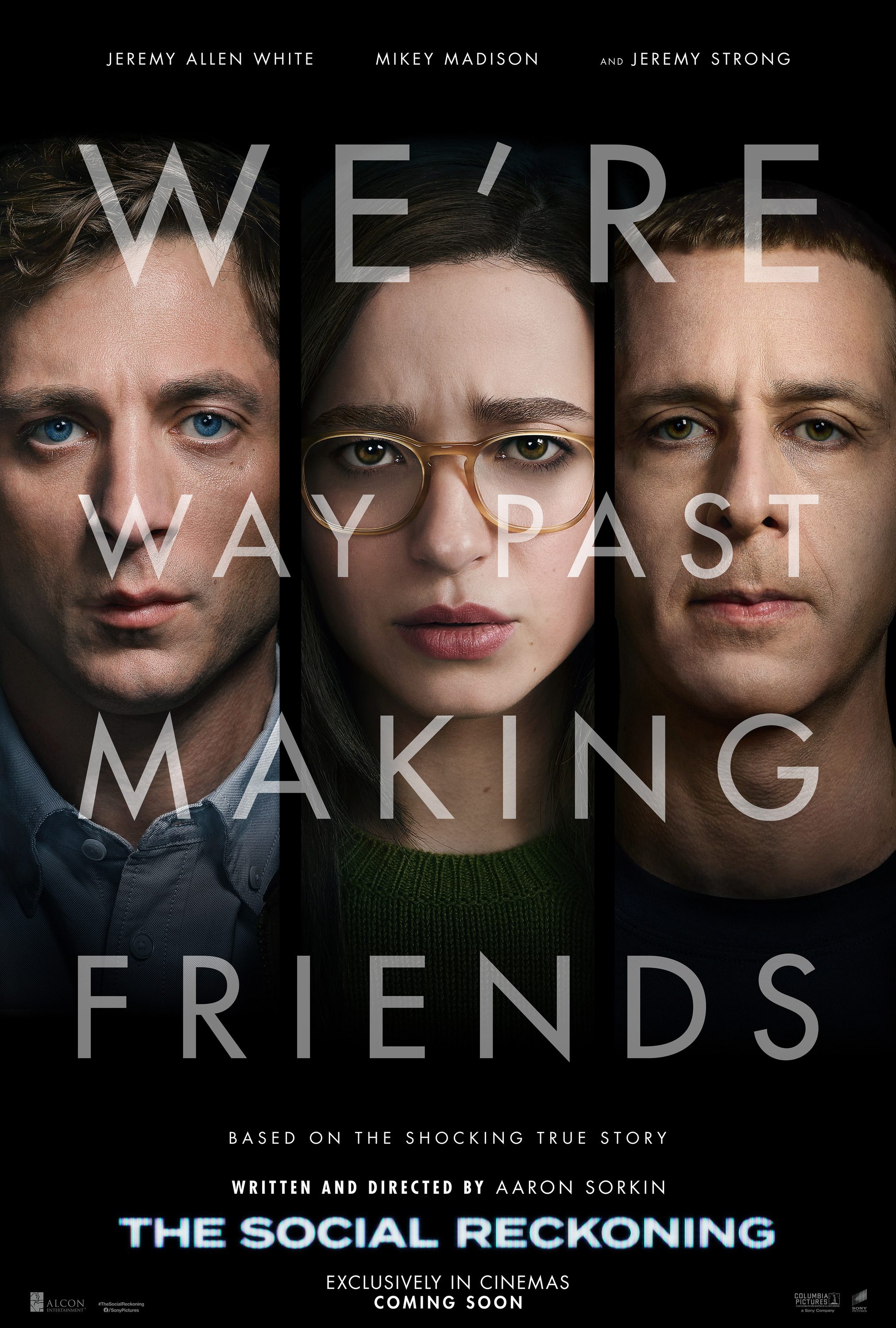
“The Social Reckoning” follows Frances Haugen, a young Facebook engineer who enlists the help of a Wall Street Journal reporter to blow the whistle on the social network’s most guarded secrets. It’s a companion piece to David Fincher’s 2010 film “The Social Network.”
Things are very different today than when “The Social Network” was released. Facebook has acquired major platforms — Instagram, WhatsApp and others — to increase its reach, with the parent company eventually rebranding to Meta in 2021. Not everything is as positive as it may seem on the surface, however. There have also been massive data breaches, algorithmic malpractice and documented physical and mental harm among users. That leads us to writer-director Aaron Sorkin’s “The Social Reckoning.”
There’s one other thing that’s different here: Mark Zuckerberg, or the actor who plays him, that is. In “The Social Network,” Jesse Eisenberg perfectly portrayed the brilliant, scatterbrained nature of the character. He was charismatic while still making you despise Zuckerberg’s actions because of his complete lack of empathy. Here, he’s just sad. That emotionless quality remains, but Jeremy Strong (Mark Zuckerberg) tries so hard to be the “bad guy” that he becomes almost insufferable to watch. What you get is a caricature that plays into every stereotype without actually carrying weight. Strong looks the part and sounds the part, but his portrayal feels completely different from Eisenberg’s. Thankfully, it’s not Zuckerberg’s movie this time around.
Instead, Mikey Madison (Frances Haugen) is at the center. This is her first major role since “Anora,” and it’s a big one. Madison is forced to regurgitate a lot of intricate information while also displaying signs of anxiousness and overbearing stress. She prevents the long-winded bouts of exposition from becoming tedious by adding personality to them. Jeremy Allen White (Jeff Horwitz) is also integral. White delivers dialogue in an articulated yet clumsy fashion. The running joke is that his character isn’t the “smartest,” and his delivery and mannerisms help to make Jeff seem like any ordinary guy regardless of his deeply complex work.
Despite Madison and White’s efforts, there’s still a sense of melodrama to their performances. Sorkin’s screenplay and direction play a role in this. The dialogue takes a major step down from “The Social Network,” with forced callbacks and lines that come across as unnatural. Strong, specifically, is practically robotic at times by attempting to act exactly like Zuckerberg. This affects the rest of the cast, with exchanges feeling less than organic just so the intended takeaways come across.
Nonetheless, the messaging does land. And it’s an actor you might not expect who helps cement the ideas of corporate greed, accountability and power — Billy Magnussen (Teddy Marks). Following 2025’s “Violent Ends,” Magnussen continues to venture into more serious roles. It’s his short conversation with White that encompasses everything “The Social Reckoning” condemns. Sorkin’s screenplay interweaves the buildup and payoff through nonlinear storytelling. Had it followed a traditional structure, each act of the 112-minute runtime would’ve likely felt distinctly different. By traveling forward and back in time, it keeps the overarching discussion intact without growing stale.
Director of photography Jeff Cronenweth expresses a range of emotions through the camerawork. In intense situations, it’s often honed in on characters’ faces. At the same time, subtle shakes occur to further visualize their tense states. With dialogue at the forefront, though, the visuals themselves remain fairly basic.
“The Social Reckoning” asks for pain. Viewers may feel this in the flat chronicling, but that doesn’t erase the film’s societal significance.
Rating: 2.5 out of 5
