
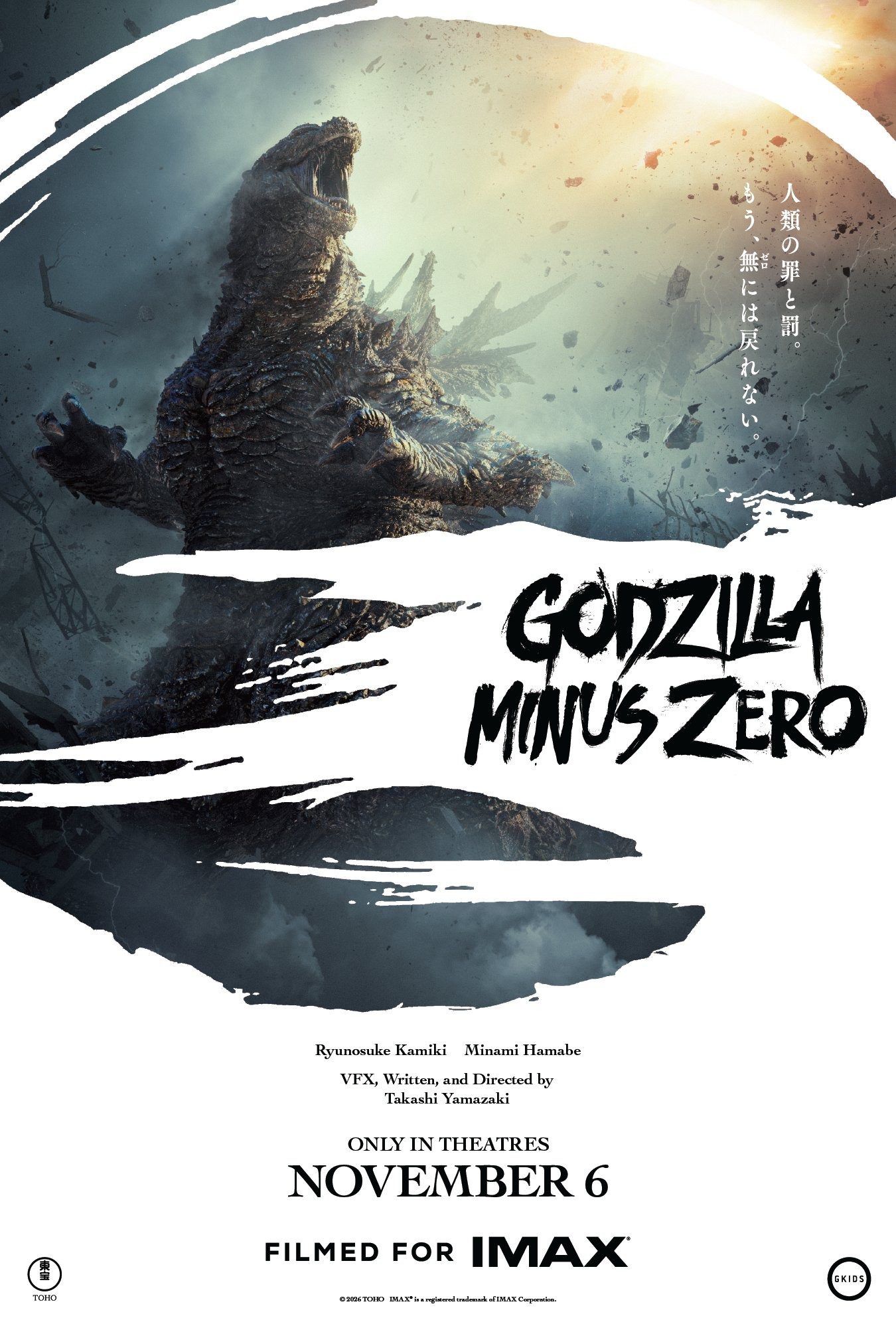
“Godzilla Minus Zero” takes place two years after the events of “Godzilla Minus One,” as Japan faces struggles to recover and reclaim daily life. Just as humanity clings to hard-won peace, a new threat emerges.
The first 90 minutes of “Godzilla Minus Zero” are more like “Godzilla Minus Godzilla.” Instead, writer-director Takashi Yamazaki unleashes King Ghidorah. The opening minutes of the film showcase the dragon-like monster in full force — well, sort of — with the complete destruction of a city. From here, it’s less Godzilla’s movie and more Ghidorah’s. Yamazaki’s script may not include much present-day Godzilla throughout the first two-thirds, but it’s not completely absent. Flashbacks are interwoven to show the carnage of the previous attack, providing glimpses of Godzilla even when Ghidorah is in the spotlight. But once again, it’s much more than just kaiju battles; this is a story about humanity.
Yamazaki explores similar themes in this second entry: grief, human resilience and war. They’re just examined through a different lens. Of course, characters grieve present-day losses, but they also mourn the world of peace that they once took for granted. Because the story follows World War II and the events of the previous film, the devastation feels almost never-ending. You can sense the immediate pain and fear that come from just the thought of another new threat arising. Many moments are void of the monsters entirely, instead focusing on the human plotlines. Kôichi Shikishima is still tormented by Godzilla. Noriko Ôishi deals with the aftermath of her injuries. Akiko watches as her parents come and go. Dr. Ogata is haunted by the memories of Hiroshima. There are numerous subplots that take up large segments of the 135-minute runtime.
At times, this creates a “waiting game.” Of course, most viewers are coming to see kaiju action. There’s plenty of that, but it’s not necessarily evenly distributed. The middle portion, specifically, is taken up entirely by these human story beats. With so much ground to cover and so many characters that the audience cares about, the film jumps around too much at times. “Minus Zero” overstays its welcome in moments, but once again, it’s hard not to root for the various personalities.
This is largely because of the performances. Ryûnosuke Kamiki (Kôichi Shikishima), Minami Hamabe (Noriko Ôishi), Jun Kunimura (Dr. Ogata), Hidetaka Yoshioka (Kenji Noda) and Sae Nagatani (Akiko) all star. It’s a quintet of emotionally impactful performances at the center, with each actor bringing their own style. Kamiki is loud in his delivery, with shouting matches and physical reactions that convey just how terrified his character is. Hamabe is his quiet counterpart, with a subtlety that grounds all of the chaos. Kunimura almost looks like a ghost at times with his blank facial expressions and defeated delivery. Yoshioka expresses kindness and sympathy through every word. Nagatani cries a lot, and she is sure to have many viewers doing the same.
“Godzilla Minus Zero” is the first R-rated movie in the franchise’s history — and you can feel it. Not only does it show the full scope of Ghidorah and Godzilla’s attacks, but also the aftermath of Hiroshima. Through flashbacks, Yamazaki further cements the anti-war messaging by doing what “Oppenheimer” didn’t. It isn’t afraid to showcase tragedy in its most brutal form.
Kôzô Shibasaki’s cinematography makes the action fully immersive. Close-up shots capture every detail on both Ghidorah and Godzilla, as well as the people caught in their path. When the giant monster showdowns begin, the camera races across landscapes and swirls around the creatures to emphasize the scale of it all. You also can’t forget about Naoki Satô’s score kicking into full gear every time Ghidorah and Godzilla appear.
“Godzilla Minus Zero” has less Godzilla, but it maintains the humanity behind the monster. The film ups the action in other ways without losing its emotional core.
Rating: 4 out of 5
