
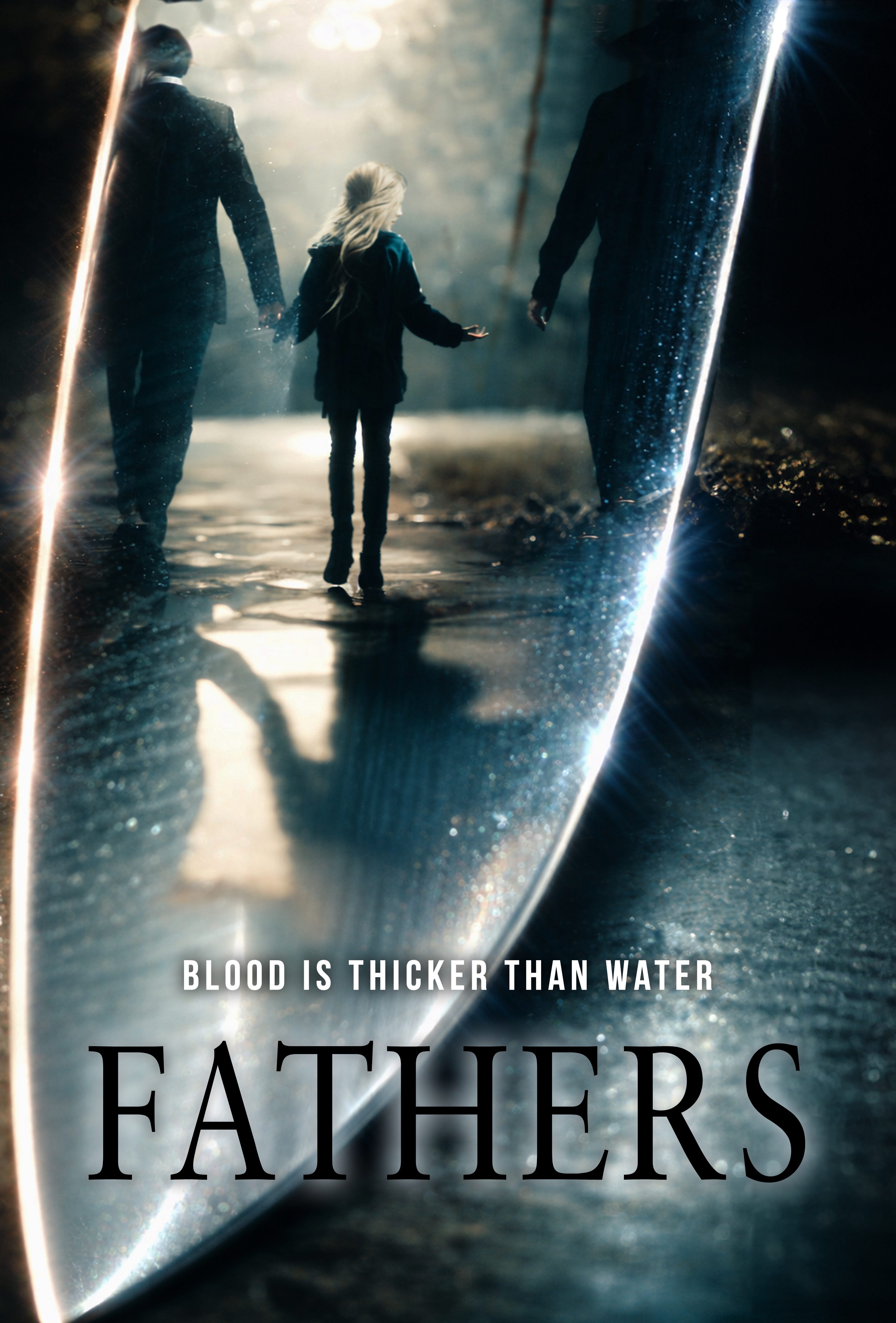
“Fathers” follows Natalie, who suddenly reappears after 15 years missing, caught between two men claiming to be her father. Embarking on a journey to uncover her identity, she becomes haunted by fragmented memories and violent echoes of her past.
The definition of a family affair, writer-director Harley Wallen (Bobby) stars alongside his real-life wife, Kaiti Wallen (Natalie), and daughter, Emilia Wallen (Young Natalie), in “Fathers.” All three deliver believable performances.
Playing a character who doesn’t have a clear sense of reality, Kaiti Wallen conveys a broken personality. For the most part, she remains quiet, letting her facial expressions do the talking instead. While not having as much screen time, Emilia Wallen is also impressive. She captures the innocence of childhood, with constant positivity that immediately makes viewers feel the weight of the tragedy that surrounds her. Harley Wallen is largely “normal,” but adds small quirks that showcase his character’s clearly sadistic nature. It’s the most charismatic performance of the cast, but he never resorts to becoming a caricature. Jerry Hayes (Calvin) also has a brief but memorable bout. He brings genuine (or so it seems) emotion that bounces off Kaiti Wallen’s more chaotic delivery.
To get it out of the way — this is an indie production with a micro budget. There are technical flaws like inconsistent sound design and jarring editing, but these don’t define the film. Instead, it’s the performances from the Wallen family that transform “Fathers” into a deeply personal and emotional story.
Another positive comes from Firoze Patel and Kaizad Patel’s musical score. The film features very “active” compositions, constantly playing throughout the 96-minute runtime. Deon Hunt also takes risks in the cinematography. While large stretches of “Fathers” feel flat, the final act, especially, grows immersive. The mixture of handheld footage, various lighting sources and close-ups help to emphasize the characters’ increasingly tense states. This results in the audience feeling the same way while watching it.
Wallen’s script is nonchronological, shifting between the present and past. The present-day narrative slowly resolves the central mystery, while flashback sequences provide context on the missing pieces. This back-and-forth approach keeps the narrative engaging, but it’s clear… one is more compelling than the other.
The glimpses of Natalie’s past are the most interesting aspect of “Fathers.” Unfortunately, however, the core question asked is answered almost immediately. It then spends most of the runtime providing additional details on this without advancing the initial concept. Because it shows too much early on, it leaves the eventual conclusion feeling clear from the start. At times, the film also relies on shortcuts — like mysterious messages on mirrors or sticky notes — to propel the narrative forward.
There’s also the fact that, in a certain sense, “Fathers” doesn’t end. Refusing to provide answers that viewers waited to see is a bold choice, one that doesn’t necessarily pay off. While Wallen hopes this will evoke equivocation, the abrupt ending really leaves the movie feeling incomplete.
Examining pain and memory, “Fathers” stumbles in its nonlinear execution, but features performances that elevate the shortcomings.
Rating: 2.5 out of 5
