
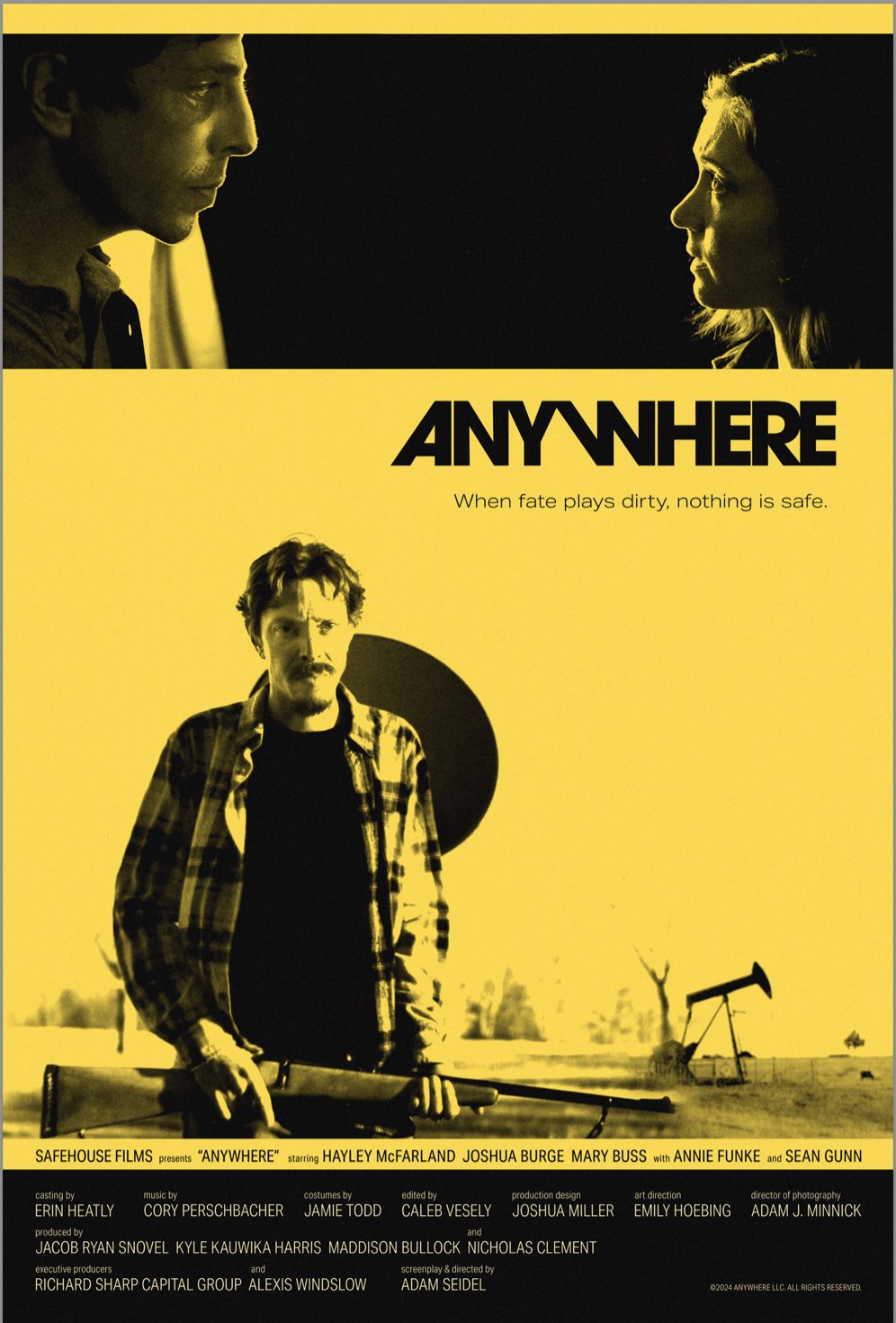
“Anywhere” follows John, a roughneck who upends the only life he’s ever known by committing a hasty crime after discovering his brother is planning to run off with his cheating wife.
Writer-director Adam Seidel presents a narrative structure that makes “Anywhere” unique compared to similar genre entries. The moment of consequence that almost every movie reaches? It doesn’t come near the end, but rather the beginning. Because of this, the initial setup is immediately riveting, certain to leave viewers wondering where it goes next.
Another 2026 crime thriller, “Carolina Caroline,” has a Bonnie and Clyde approach, while “Anywhere” is more like a one-hit wonder. And this isn’t necessarily a bad thing. Both films follow a pair of outlaws on the run, but take the narrative in a far different trajectory.
Unfortunately, here, it doesn’t go “anywhere” — for a while, at least. Seidel’s screenplay contains many moving pieces. While the overarching story is focused on John, there are a plethora of hidden agendas and secrets from other individuals as well. By diverting so much attention, the film becomes almost directionless after the sharp opening. The pacing then suffers, with subplots taking over many segments throughout the 101-minute runtime.
But the more time progresses away from the core characters, the more purposeful this world-building becomes once the concentration returns to them. Even as everything appears “normal,” the looming repercussions still cast a shadow. This keeps the intensity at a high point despite the slow-burn approach.
The themes explored in “Anywhere” aren’t new: broken families, cycles of violence, reasons for revenge and more. While other films attempt to provide solid answers, this leaves questions lingering. In each step of the journey, Seidel attempts to put the audience directly in the characters’ shoes.
“I’m a killer. Once you cross that line, there ain’t no going back.”

Amid the tragedy, Joshua Burge (John) maintains a subdued presence. He plays a timid individual, one who is forced (or rather chooses) to make ruthless decisions. No matter what goes on around him, this timid presence remains — but he can also flip a switch at a moment’s notice. Hayley McFarland (Syd) is unhinged, constantly transitioning from crazed to seductive to hopeful. Her magnetic presence contrasts well with Burge’s silence, leading to a central couple that grows more compelling with each new development. Sean Gunn (Wade) also appears. He makes the most of his limited screentime, being both restrained yet outwardly creepy in his delivery.
Director of photography Adam J. Minnick keeps the camera in close proximity to the characters’ faces. As tense and potentially life-altering events occur around them, these close-ups emphasize every ounce of emotion that they’re feeling, whether that’s hatred, sadness or fear. The intense shots can be distracting at times, however, as parts of faces move in and out of frame. Still, the visuals never remain still, tracking movements through subtle zoom-ins and pans with a handheld touch. With a warm color palette, the overall aesthetic is gritty and hard-nosed, much like the rural Oklahoma landscape it takes place in.
The sound design and musical score from Cory Perschbacher play a key role in this. Rather than relying on the imagery alone, heightened audio seeps in to fill the void.
“Anywhere” doesn’t reach “anywhere” near its introductory promise, but a tale of consequence and choice remains. It’s an unhurried story that begins and ends with a bang.
Rating: 3 out of 5
