
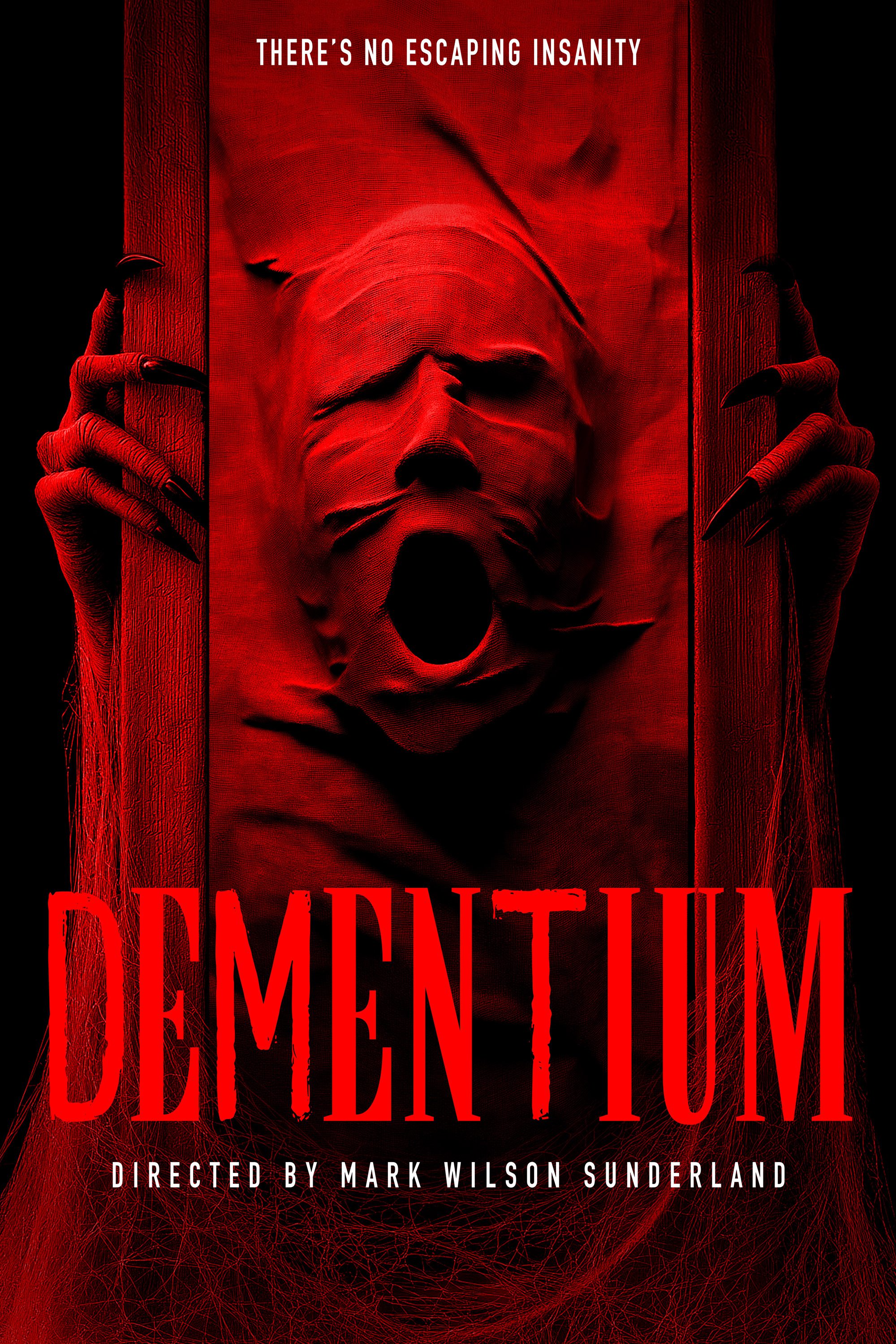
“Dementium” follows Wyatt Bailey, who retreats to a secluded cabin to uncover the truth about his mother’s murder. Ending up trapped in a drug-fueled nightmare, he must decide whether the truth will destroy him or set him free.

Following a non-chronological order, co-writer and director Mark Wilson Sunderland transitions between the past and present. By showing a stark contrast between Wyatt’s stoic modern personality and his more “loving” history, it creates immediate skepticism of his intentions. Oh, and of course… the fact that a casket is sitting on his dinner table. As it progresses, some of these flashbacks are further woven into the character’s reality. Because Wyatt actively watches and reflects on these moments himself alongside the audience, they begin to fit more seamlessly into the narrative.
This does lead to a problem: these flashbacks start taking over the movie. When a single memory extends for almost 20 minutes of the 92-minute runtime, that detracts from the present-day events. With this, however, comes the most impactful themes within “Dementium” — covering addiction, relationships and recovery. Despite becoming a less-than-cohesive experience as a whole, hopeful messaging lingers from Clayton Thompson, Mark Wilson Sunderland and Kyle Sunderland’s script in the end.
Michael Aaron Milligan (Wyatt) is the focus of this character study. Milligan begins the film almost silently but adds more layers to the character as the story progresses. With this, he brings both sadness and anger to the screen as Wyatt comes to terms with various aspects of his life. While the horror itself is sometimes pushed to the side, he also delivers adequate fear to sell the scares when they do occur. Karynn Moore (Cora) is the emotional backbone of the film, showing the “good” that is inside of Wyatt despite all the bad around him. She carries lengthy sequences of dialogue as the two bounce off each other with believable chemistry.

“Dementium” is closer to a psychological thriller than it is horror. There are horrific aspects to the plot, but they feel like an afterthought more often than not. As dramatic undercurrents come further into the light, even that takes center stage over the terror. The film has comedic tendencies as well. It includes black-and-white drug infomercials featuring a crazed scientist. In Wyatt’s drug-induced state, there’s also a witch. Both are played by Doug Dawson (Witch/Scientist), whose exaggerated delivery generates some laughs. At the same time, Dawson also executes scares by cackling and clapping outside of windows or in corners of rooms.
The sound design is heightened in “Dementium,” often feeling like noises are coming from every direction. Simple sounds like sizzling food, running water or a vibrating phone are purposefully jarring, immediately heightening the tension. This, mixed with Jonathan Thomas Maiocco’s score, gives the film a consistent dose of auditory stimulation.
Director of photography Nathan Rigaud takes advantage of the remote environment. Transitioning between lush outdoor settings and dark home corridors, the characters are framed purposefully to achieve the desired tone. Largely composed of close-up shots, Rigaud utilizes camera pans to reveal additional details.
“Dementium” is a journey through the past to uncover traumas of addiction and loss. While the scares are sparse, it still has something to say within.
Rating: 3 out of 5
