
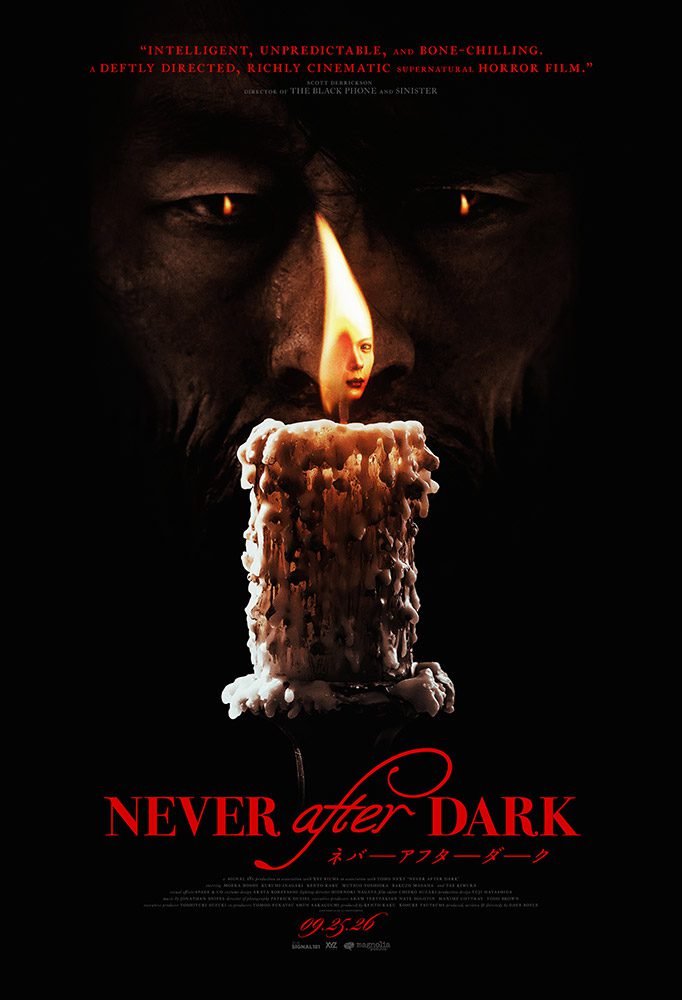
“Never After Dark” follows Airi, a wandering medium who comes face-to-face with a grotesque apparition with powers that defy her experience.

Writer-director Dave Boyle centers “Never After Dark” on a complicated character. It’s evident that she’s grappling with trauma from loss and the abilities she possesses. At times, it may seem like she is a “scam artist.” In others, it’s clear that her work is very much real. By alienating Airi from everyone else in the movie, Boyle brings her closer to the audience. This heightens investment in the character and also makes the dread of what surrounds her feel so real.
Despite the well-established hostility, “Never After Dark” doesn’t consistently maintain it. The first hour of the film builds up the mystery, only to slightly lose its grasp on it in the final act. This is mainly because the seclusion factor is diminished, resulting in more moving pieces that take away from the actual threat. While Boyle’s screenplay was initially concise, it eventually becomes convoluted with many other ideas to keep track of. Consequently, the pacing of the 104-minute runtime falters, shifting from prolonged to abrupt without complete cohesion.
Moeka Hoshi (Airi) has subdued, cautious energy as Airi. Because she is often alone, it’s not always a verbal performance. Hoshi’s physical delivery proves more important as she expresses nervousness and fright through facial expressions. Kurumi Inagaki (Miku) almost acts as a viewer in “Never After Dark.” Portraying the deceased sister, Miku is a vessel for exploring the ins-and-outs of Airi as an individual. Despite the exposition itself feeling forced at times, Inagaki succeeds in making the sisterly relationship feel real.
Kento Kaku (Gunji) is initially skeptical and straightforward. It becomes a much more layered performance as the film progresses, which contrasts well with his early routineness to round out the character. Tae Kimura (Teiko) is frantic and anxious in her delivery, which is exactly how you would expect someone to act when met with terrifying spirits. No matter how he appears, Mutsuo Yoshioka (The Man/The Gaping Mouth Man) has a menacing presence. For most of the movie, it’s purely a physical performance. Eventually, however, it becomes dialogue-heavy. He excels in both forms, creating an villain that is “scary.”

Production designer Yuji Hayashida plays a big role in the film’s overall ambiance. “Never After Dark” takes place inside a large country house that has an old-fashioned look, achieved through antique wooden furnishings and decor alike. It also has many peculiarities, featuring wide-ranging spaces like the living room and kitchen areas, as well as dozens of smaller rooms and narrow hallways. Because it’s a former hotel converted into a private residence, the setting takes on vibes similar to “The Shining.” Mixed with the tree-filled land outside of the home, it becomes a very isolating environment that generates constant tension.
The imagery aids in this creepiness. Director of photography Patrick Ouziel takes advantage of the space with dolly shots down corridors or tracking shots up staircases. Rather than keeping the camera locked in place, the repeated movement puts viewers in Airi’s shoes as she navigates the different areas. Boyle and Ouziel also visualize entities in various ways, both in-camera and through reflections and shadows, keeping the line between reality and illusion blurred. The film is littered with impressive practical effects. This not only includes carnage — teeth pulling and bloody wounds — but also objects slowly moving or sporadically flying without being touched.
Jonathan Snipes’ score presents an additional layer of unease. There are traditional musical compositions included, but also multi-pitched hums, sharp piano notes and crackling sounds that appear in key moments. These are integrated into the already-chaotic soundscape, making them feel like they’re a part of the world rather than just added in.
“Never After Dark” takes elements from “The Shining” and “The Conjuring” and forms them into a genre amalgam. It’s a seemingly traditional haunted house story that becomes something much more unique.
Rating: 3.5 out of 5
