
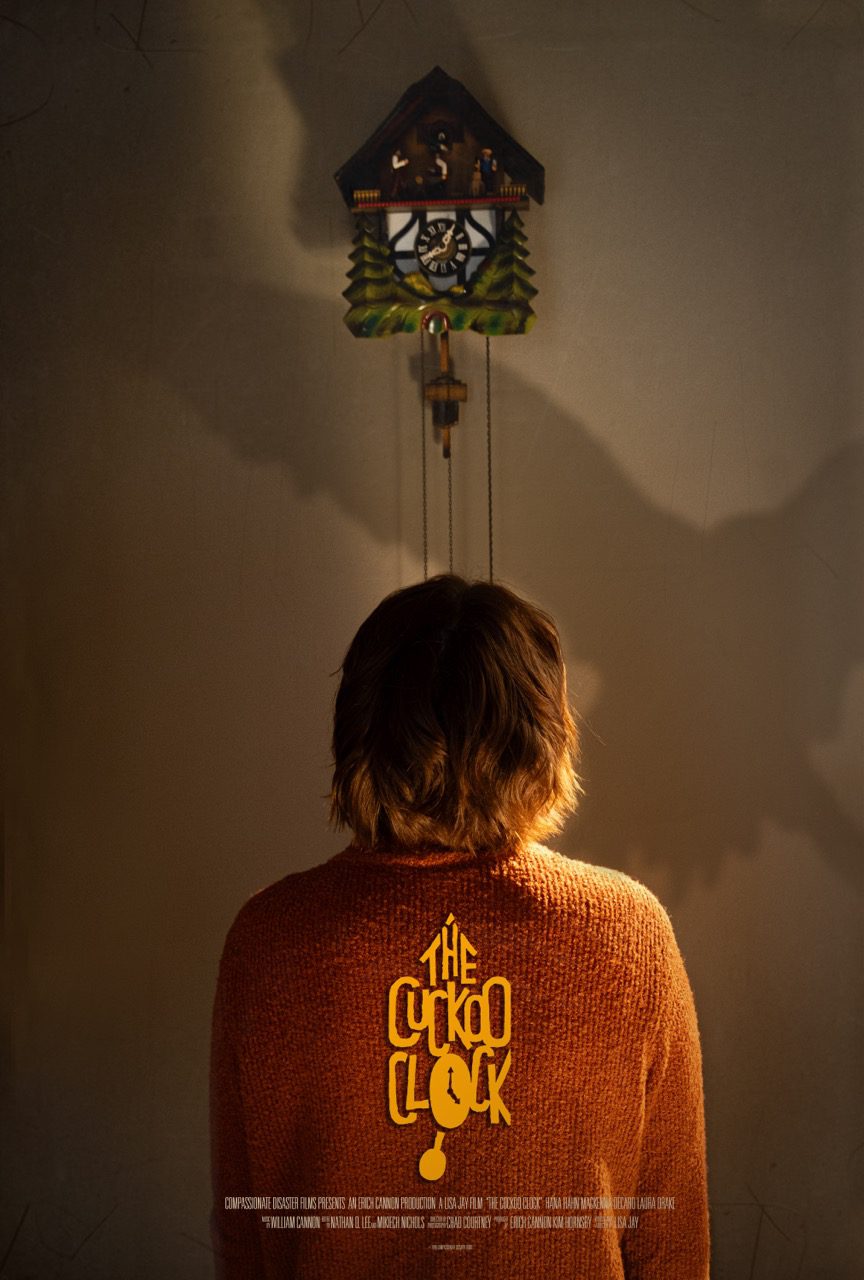
“The Cuckoo Clock” follows Penny, a young woman who falls in love with her grandmother’s in-home nurse. After the nurse disappears, a cuckoo clock begins speaking to her with a warning of who might be responsible.

Throughout much of “The Cuckoo Clock,” you can hear ticking in the background. Whether it’s a silent scene or a loud one, that sound remains. This is crucial to the film’s gradual buildup of tension, making it feel like a countdown to imminent doom.
Writer-director Lisa Jay’s screenplay is concise yet fragmented. As she examines the three central characters — Penny, Megan and Adele — not much time is spent on individual moments. Questions are raised regarding the characters’ intentions. Mysterious individuals show up. Strange “glitches” appear out of nowhere. Nonetheless, the film moves forward without dissecting what has occurred. Whether through cross-fade or fade-to-black transitions, scenes come and go without resolution. By only showcasing instances rather than entireties, the audience is left in the dark regarding detailed aspects of the individuals.
Certain parts of “The Cuckoo Clock” feel out of place, but they do serve a purpose. Eventually, sequences become elongated rather than short-lived, allowing the blurry character dynamics to grow more clear and the horrors to become more apparent. Jay adds new pieces of information bit by bit, leaving the payoff for the film’s second half.
All of this culminates in an ending that can only be described as bizarre. Impressive effects take over the conclusion of the film, including bloody carnage on top of other strange apparitions. All I’ll say is that it’s shockingly comparable to “The Thing with Feathers.” It may be metaphor-heavy, but these heightened moments don’t feel abstract in the world of “The Cuckoo Clock.” It actually seems like the only natural conclusion to a movie about a talking cuckoo clock, one that will either have you gasping or groaning. There’s probably no in-between.
Director of photography Chad Courtney keeps the camerawork simple. Taking place inside an ordinary home, the visuals look largely… ordinary. Other creative choices are executed in spurts, however, like Dutch angles and POV-style shots. Old footage is also intermixed with present-day events to show the impact of Adele’s dementia. What was once a lively and nostalgic past is no longer that, forgetting things about those around her and spending most of her days relegated to bed. While there are moments where it feels like the clips are inserted sporadically, the characters also interact with them. This makes them feel like a fundamental part of the narrative rather than just a way to fill out the 91-minute runtime.
If you come to “The Cuckoo Clock” for the basic premise alone, be warned — it has much more going on than a “talking cuckoo clock.” While that is a piece of the story, it’s a surprisingly small one. Instead, Jay pushes the slow-burn horror in a variety of real and supernatural directions. Still, there is plenty of humor in watching Hana Hahn (Penny) interacting with the talking timepiece.
“Don’t do it. Don’t do it. Don’t do it. Don’t do it.”

Hahn plays a person who is going through a multitude of feelings. Of course, she loves her grandma. But she’s also put in a terrifying situation that makes her question this love. Hahn conveys both sides of the character well, putting viewers directly in her shoes through it all. Laura Drake (Adele) delivers believable forgetfulness mixed with a bit of deceit. The horrors of dementia are at the core of the film, and she perfectly rides the line between outward mental degradation and inner malice. Because of her performance, you aren’t able to tell whether the character’s actions are fully intentional or not. Makenna DeCaro (Megan) is equally complex. You’re also meant to question her character at times, and DeCaro lays the groundwork for that doubt.
“The Cuckoo Clock” presents a string of seemingly disconnected scenes that somehow mesh. It’s deliberately paced and evidently weird, forming an engaging mixture of supernatural horror that’s hard to look away from.
Rating: 3.5 out of 5

